
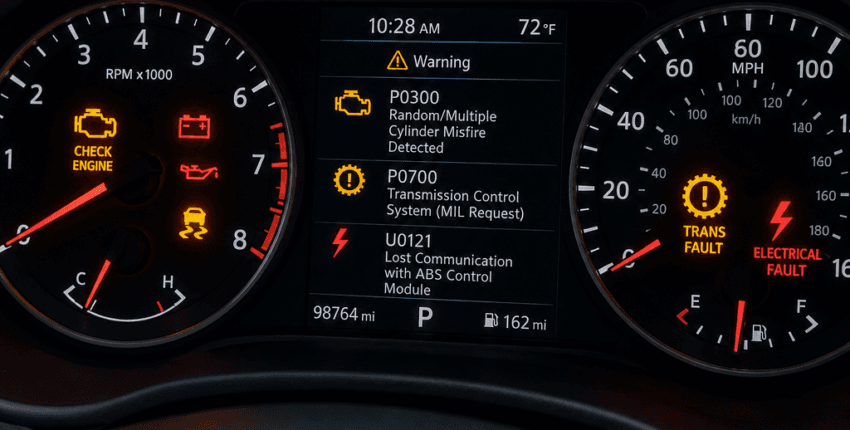
Most drivers ignore early warning signs until a minor fault becomes a major repair bill. In Townsville’s heat and humidity, vehicle electronics degrade faster than in cooler climates, and a standard code reader from a parts store will not catch half of what is actually going wrong inside your car’s modules. Advanced car diagnostics Townsville drivers need goes far beyond pulling a fault code. It means live data analysis, module communication testing, and pinpointing faults that generic tools cannot even see. If your car is showing any of the signs below, waiting is costing you money.
Table of Contents
- Quick Takeaways
- Why Generic Diagnostics Fail Modern Vehicles
- Warning Sign 1: The Check Engine Light Keeps Coming Back
- Warning Sign 2: Erratic or Harsh Transmission Behaviour
- Warning Sign 3: Multiple Warning Lights On at the Same Time
- Warning Sign 4: Unexplained Electrical Gremlins
- Warning Sign 5: Starting Problems and Immobiliser Faults
- Warning Sign 6: Driver Assistance Systems Acting Up
- Comparing Diagnostic Approaches: What Actually Works
- What Advanced Car Diagnostics Actually Involves
- Frequently Asked Questions
- References
Quick Takeaways
| Key Insight | Explanation |
|---|---|
| A check engine light that returns after clearing is not a sensor glitch | It signals an underlying module or wiring fault that only factory-level diagnostics will find |
| Harsh or delayed gear shifts often point to a TCM (Transmission Control Module) fault | Standard transmission fluid services will not fix a module programming issue |
| Multiple simultaneous warning lights usually indicate a CAN bus communication failure | This requires module-level scanning, not individual sensor replacement |
| Intermittent electrical faults are the hardest to diagnose with basic tools | Live data logging and oscilloscope testing are required to catch faults that come and go |
| Immobiliser and key programming faults lock you out of your own vehicle | Only a workshop with OEM-level programming access can resolve these without replacing the entire BCM |
| ADAS calibration errors after a windscreen replacement cause real safety risks | Camera and radar modules must be recalibrated using manufacturer-specific software |
| Townsville’s heat accelerates ECU and module failure rates | Vehicles in Far North Queensland develop electronic faults earlier than the national average |
Why Generic Diagnostics Fail Modern Vehicles
A plug-in OBD2 scanner from an auto parts store reads a narrow slice of data. It pulls fault codes from the engine control module and sometimes the transmission, but it communicates with only a fraction of the modules sitting on your vehicle’s network. A modern vehicle can have 70 to 150 separate electronic control units, all talking to each other over a CAN bus, LIN bus, or FlexRay network.
When a generic tool shows no fault codes, many workshops declare the car fine. In practice, this is where expensive diagnostic mistakes happen. The fault is still there, it is just sitting in a body control module, a gateway ECU, or a suspension control unit that the basic scanner never interrogated. The data consistently shows that misdiagnosis from incomplete scanning is one of the leading causes of repeat workshop visits.
Pro tip: If a workshop cannot show you a full module scan report listing every module on your vehicle’s network and its communication status, they have not completed a proper diagnostic. Ask for this report before authorising any repairs.
Warning Sign 1: The Check Engine Light Keeps Coming Back
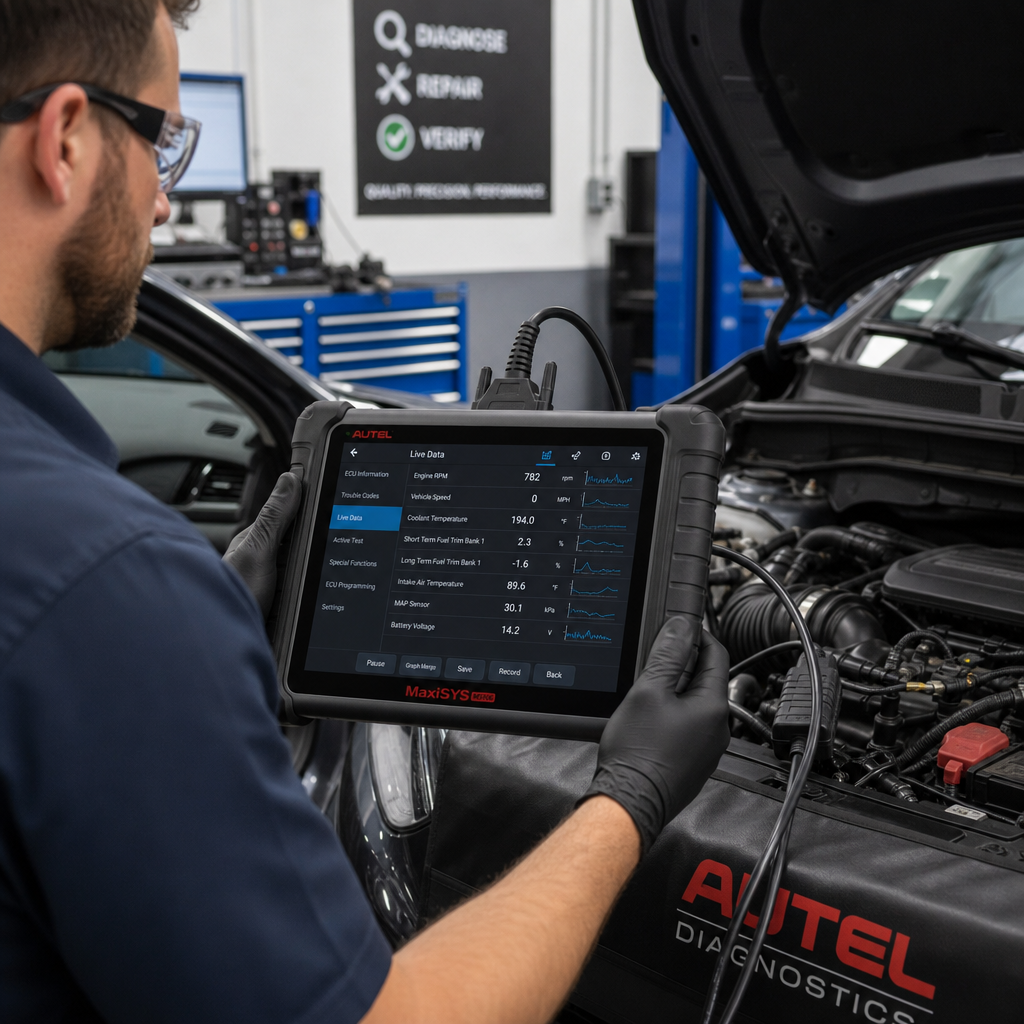
If a workshop clears your check engine light and it returns within days or weeks, the root cause was never fixed. Clearing a fault code without finding the source is the automotive equivalent of pulling a smoke alarm battery. The problem is still burning.
What the light is actually telling you
A persistent check engine light in vehicles manufactured after 2010 almost always points to either a failed sensor sending incorrect data to the ECU, a wiring harness fault causing intermittent signal loss, or an ECU that has developed an internal processing error. All three require live data analysis, not just a fault code read.
In practice, the most commonly misdiagnosed check engine faults in Townsville workshops involve oxygen sensors that test fine in isolation but fail under load, and fuel trim errors caused by injector driver circuit faults inside the ECU itself rather than by the injectors.
When ECU repair or cloning is the real answer
A common mistake is replacing perfectly functional sensors because they registered a fault code, when the actual problem is an ECU that is misinterpreting or corrupting the signal. ECU repair and cloning at a specialist level resolves this without the cost of a new ECU and without the reprogramming complications that come with fitting a second-hand unit from a wrecker.
Warning Sign 2: Erratic or Harsh Transmission Behaviour
Harsh gear changes, slipping between gears, delayed engagement when pulling away from a stop, or a transmission that seems to hunt between gears are all symptoms that most drivers blame on the transmission mechanically. In a significant number of cases, the mechanical components are completely fine. The fault lives inside the Transmission Control Module.
The TCM controls shift timing, torque converter lockup, and line pressure based on sensor inputs. When the TCM develops a fault, whether from heat damage, voltage spikes, or corrupted software, it sends incorrect commands to perfectly good solenoids. The transmission behaves erratically not because of a worn clutch pack but because its instructions are wrong.
Electronic transmission repairs and programming require a workshop with OEM-level access to the TCM’s software architecture. Without it, the only option most workshops offer is a full transmission rebuild or replacement, which is the wrong repair for a programming or module fault.
Pro tip: Before authorising any transmission rebuild on a vehicle under 200,000 km, insist on a full TCM diagnostic scan with live data. A rebuild that does not address a TCM fault will fail again within months.
Warning Sign 3: Multiple Warning Lights On at the Same Time
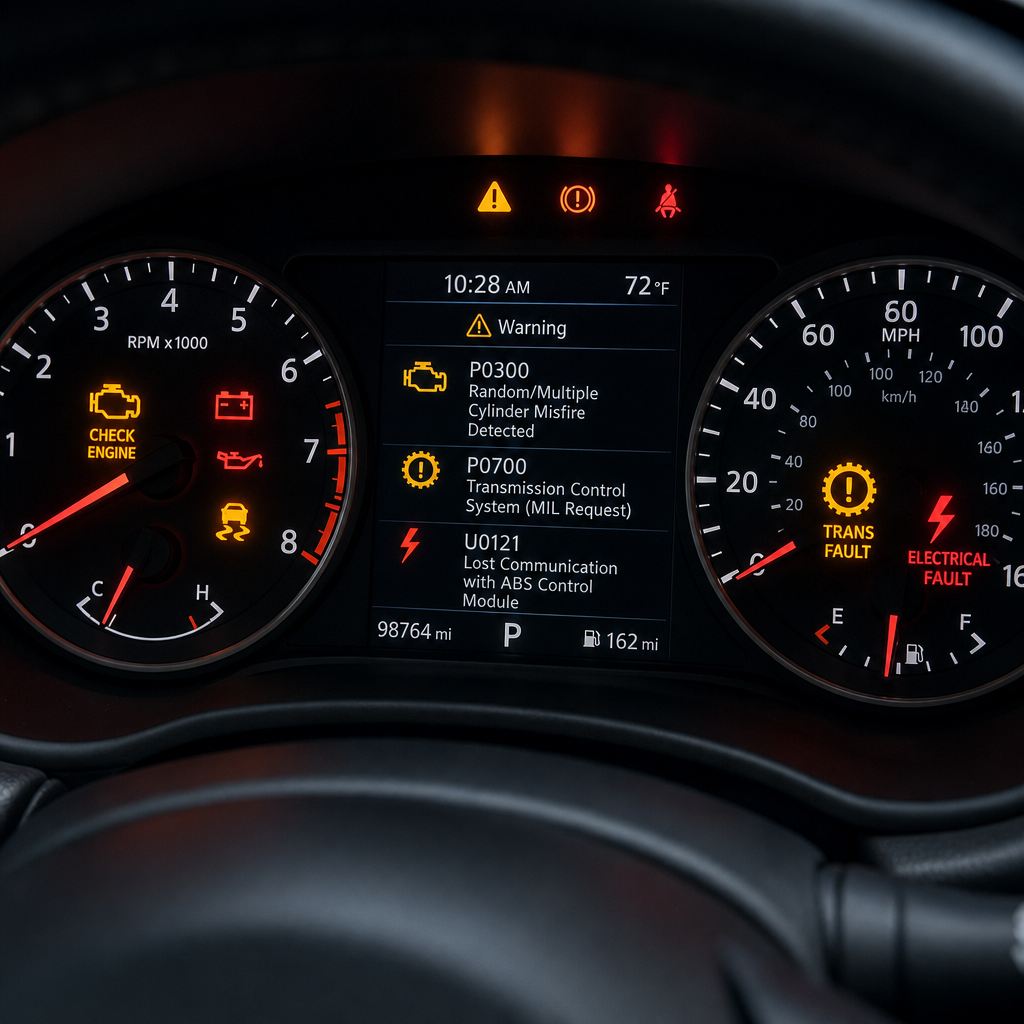
When two or more unrelated warning lights illuminate simultaneously, most drivers assume their car has developed multiple problems at once. The more likely explanation is a single point of failure upstream. The most common cause is a CAN bus communication fault.
Understanding CAN bus failure
The CAN bus is the communication network that allows all your vehicle’s modules to share data. If a module on the network fails or a wiring fault introduces noise or a short into the bus, multiple modules lose the data they depend on and trigger warning lights as a result. You might see the ABS light, stability control light, and power steering warning on together, not because all three systems failed, but because the module supplying wheel speed data to all three went offline.
Diagnosing this correctly requires a scan tool that can map which modules are communicating and which have dropped off the network, combined with oscilloscope testing of the CAN bus signal quality. A basic scanner will show fault codes in three separate systems and an inexperienced technician will start replacing parts in all three.
Warning Sign 4: Unexplained Electrical Gremlins
Windows that stop halfway, interior lights that flicker randomly, accessories that work one day and not the next, central locking that responds slowly or inconsistently. These intermittent faults are among the most frustrating for drivers and the most frequently misdiagnosed by workshops without advanced diagnostic capability.
The reason intermittent faults are so difficult is that they are often absent when the vehicle arrives at the workshop. A technician who relies on fault codes will see a clear system and send the car home. The fault returns as soon as the driver leaves the car park.
In practice, catching intermittent faults requires a combination of live data logging over time, freeze frame analysis, and in many cases an oscilloscope to check signal integrity on body control module inputs and outputs. This is exactly the kind of work that separates a specialist auto electrician from a general mechanic with a code reader.
Warning Sign 5: Starting Problems and Immobiliser Faults
A car that cranks but will not start, or that starts intermittently, is commonly misdiagnosed as a fuel or ignition problem. When those systems check out fine, the fault often lies in the immobiliser system, the Body Control Module, or the key transponder communication chain.
Modern vehicles use rolling code immobiliser systems where the key fob, BCM, and ECU must all agree on a security handshake before the engine is allowed to start. A fault in any one of these components, or a corrupted security table inside the ECM, will prevent starting with no obvious mechanical cause.
Module programming and cloning is frequently the most cost-effective solution here. Rather than replacing the BCM and ECU together (which requires a full system reprogram and can cost thousands), a specialist can repair or clone the affected module and retain the original security configuration. This is a technically demanding process that requires manufacturer-level programming access, which is not available at general repair workshops.
Warning Sign 6: Driver Assistance Systems Acting Up
Adaptive cruise control that disengages randomly, lane keep assist that pulls erratically, automatic emergency braking that activates without reason. These are not software bugs to ignore. They are signs that a sensor module has failed or that an ADAS module has not been correctly calibrated after a repair.
The most common trigger for ADAS faults that drivers do not connect to a recent repair is windscreen replacement. The forward-facing camera module is mounted to the windscreen on most vehicles manufactured after 2015. When the screen is replaced, the camera must be recalibrated to the new screen’s optical properties using manufacturer-specific software. A workshop that replaces the screen without performing this calibration hands back a vehicle with a compromised safety system.
Diagnosing ADAS faults correctly requires factory-level access to radar, camera, and lidar module data streams. This is advanced car diagnostics work, not a standard mechanical inspection.
Comparing Diagnostic Approaches: What Actually Works
Not all diagnostic services are equal. The difference in what each approach can actually find is substantial, and choosing the wrong level of service wastes both time and money.
| Diagnostic Approach | What It Covers | What It Misses |
|---|---|---|
| Basic OBD2 Scan (parts store or generic tool) | Engine and sometimes transmission fault codes only | Body modules, ADAS, immobiliser, CAN bus faults, live data analysis, all non-powertrain modules |
| Multi-system scan at a general workshop | Fault codes from most major systems | Live data correlation, module communication mapping, oscilloscope signal testing, programming faults |
| Advanced diagnostics at a specialist auto electrician | Full module network scan, live data logging, CAN bus analysis, oscilloscope testing, ADAS calibration, ECU and TCM programming faults | Nothing that is electrically or electronically diagnosable is outside scope |
The data consistently shows that vehicles sent through advanced diagnostics first resolve faster and with fewer unnecessary parts replaced. Spending on proper diagnostics upfront saves money compared to the trial-and-error parts replacement that happens when basic tools are used on complex faults.
What Advanced Car Diagnostics Actually Involves
When someone searches for car diagnostics Townsville, they often expect a 15-minute scan and a list of fault codes. Real advanced diagnostics is a structured investigation, not a code print-out.
It starts with a full module network scan that documents every ECU on the vehicle and confirms which ones are communicating correctly. From there, live data streams are analysed under real operating conditions, because many faults only appear under load or at operating temperature. Wiring integrity is tested with an oscilloscope rather than just a multimeter, because a wire can show correct resistance and still carry a corrupted signal.
“The difference between a code reader and a factory diagnostic tool is like the difference between a thermometer and a full medical workup. One tells you something is wrong. The other tells you why.” – Twin Cities Auto, Townsville
For module programming faults, the technician needs access to manufacturer-level programming platforms. This is not available through aftermarket scan tools. It requires either direct OEM software access or a subscription to platforms like Autel, Bosch ESI, or factory pass-through programming. This is what separates a true specialist from a workshop that invested in a mid-range scan tool.
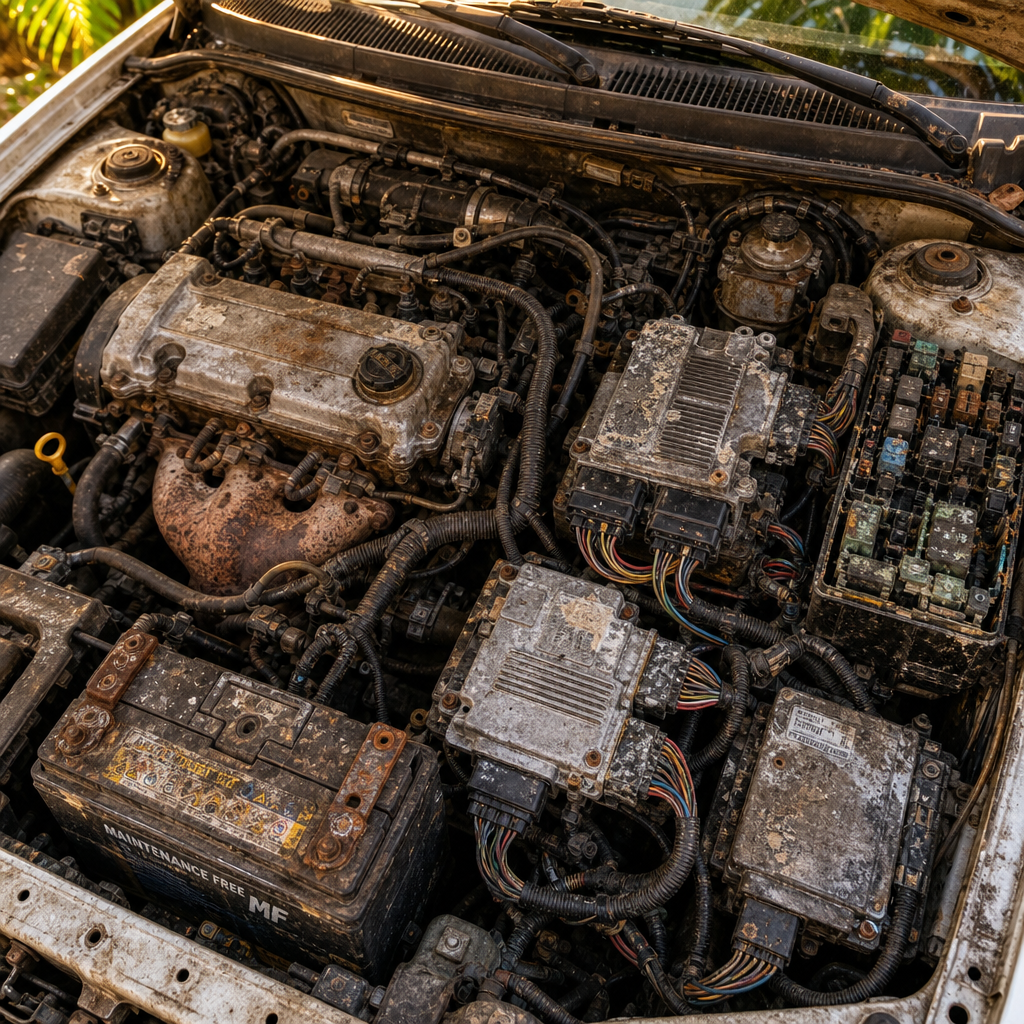
Townsville’s climate adds an additional diagnostic dimension. Extreme heat causes solder joint fatigue inside ECUs, accelerates capacitor failure on circuit boards, and degrades wiring insulation faster than in southern states. A workshop in Townsville that specialises in electronic module repairs understands these local failure patterns in a way that a general mechanic simply does not.
Frequently Asked Questions
How do I know if my car needs advanced diagnostics rather than a standard service?
If your car has any warning lights that keep returning after being cleared, unexplained electrical behaviour, intermittent starting problems, or erratic transmission shifts, standard servicing will not find the root cause. These symptoms require module-level scanning and live data analysis that only a specialist workshop can provide.
Can a check engine light indicate an ECU problem rather than a sensor fault?
Yes, and this is one of the most commonly missed diagnoses. An ECU that has developed an internal fault can generate sensor-related fault codes even when the sensors themselves are functioning correctly. Advanced diagnostics can distinguish between a sensor fault and an ECU processing fault, saving the cost of replacing sensors that are not actually defective.
What is the difference between ECU cloning and ECU replacement?
ECU cloning involves transferring the exact software, calibration data, and security configuration from a faulty ECU to a replacement unit. This means the replacement ECU is immediately compatible with the vehicle’s immobiliser, key system, and module network without additional programming. A replacement ECU from a wrecker or dealer requires extensive reprogramming and may not retain the vehicle’s individual calibration settings.
Why are Townsville vehicles more prone to electronic faults than vehicles in other parts of Australia?
Sustained high temperatures in North Queensland accelerate the degradation of electronic components significantly. Capacitors inside ECUs fail earlier under constant heat stress, solder joints develop cracks from repeated thermal expansion and contraction, and wiring insulation becomes brittle faster. Vehicles in Townsville typically develop electronic faults two to four years earlier than the same models in Sydney or Melbourne.
Is it worth repairing or cloning a module rather than buying a new one?
In most cases, yes. A new OEM module costs two to four times more than a repair or clone, and a second-hand module from a wrecker introduces compatibility and security programming complications. Module repair and cloning by a specialist retains the original vehicle configuration and costs significantly less. The only situation where a new module is preferable is when the original has suffered physical damage beyond repair.
Can an auto electrician in Townsville handle programming for all vehicle brands?
A specialist workshop with access to multi-brand programming platforms can handle most makes and models, including European, Japanese, Korean, and American vehicles. The key is whether the workshop holds subscriptions to manufacturer-specific or multi-brand programming platforms. Not every workshop that calls itself an auto electrician has this capability. Ask specifically whether they can handle your make and model before booking.
Have you experienced a fault that was misdiagnosed by a workshop using only a basic scan tool? Share what happened and how it was eventually resolved.
References
- SAE International, technical standards and research for automotive electronic systems and diagnostics
- Statista, automotive industry data including vehicle electronics market size and fault statistics
- Forbes, automotive technology and repair industry analysis and cost trends
- Australian Automotive Aftermarket Association, industry standards and repair guidelines for Australian workshops