
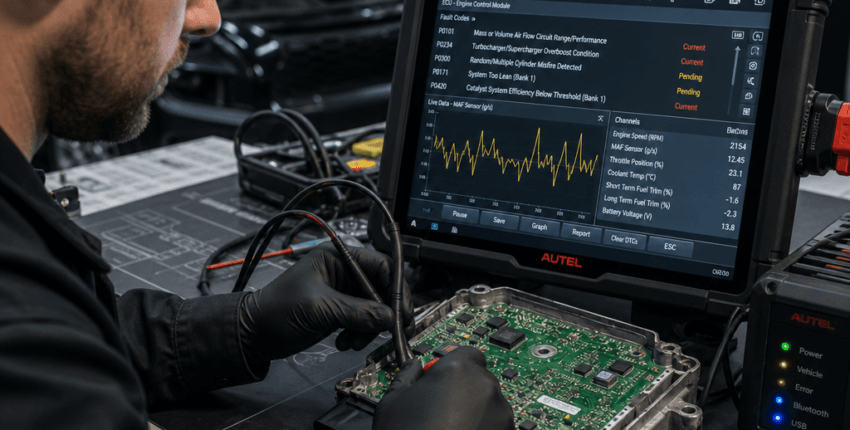
Modern vehicles carry more electronics than a commercial aircraft cockpit, and when those systems fail, most workshops in Townsville simply cannot cope. Fault codes get cleared, parts get swapped, and owners drive away with the same problem dressed in a different symptom. Vehicle electronics repair in Townsville has a serious competence gap, and it shows up every week in the diagnostic bay at Twin Cities Auto. This article breaks down what genuine all-brand electronic repair looks like, why module programming matters more than ever, and exactly how Twin Cities Auto approaches problems that other shops refuse to touch.
Table of Contents
- Quick Takeaways
- Why Vehicle Electronics Fail More Often Than You Think
- What Module Programming Really Involves
- ECU Repair vs ECU Replacement: The Real Cost Comparison
- All-Brand Capability: Why It Matters in Townsville
- Advanced Diagnostics Beyond the Code Reader
- Electronic Transmission Repair and Programming
- What Sets Twin Cities Auto Apart from Local Competitors
- Frequently Asked Questions
- References
Quick Takeaways
| Key Insight | Explanation |
|---|---|
| Module programming is not optional on modern vehicles | Replacing an ECU or body control module without correct programming leaves the vehicle in a non-start or limp-home condition regardless of part quality. |
| ECU cloning preserves your vehicle’s identity data | Cloning transfers calibration, immobiliser data, and VIN-linked parameters from a faulty unit to a repair unit, avoiding costly dealer re-registration. |
| Generic scan tools miss CAN bus and LIN bus faults | Twin Cities Auto uses manufacturer-level diagnostic software that reads every sub-network, not just the OBD-II port summary a code reader provides. |
| All-brand coverage means one workshop for every make | Whether the vehicle is a Toyota Land Cruiser, a European BMW, or a Korean Hyundai, Twin Cities Auto holds software licences and tooling for each platform. |
| Electronic transmission faults are diagnosable without replacement | TCM reprogramming and solenoid circuit testing resolve the majority of shift-quality complaints that dealers quote as full transmission replacements. |
| Auto electrical faults escalate when left untreated | A single ground fault or voltage drop can corrupt module memory over time, turning a simple repair into a multi-module replacement if ignored. |
| Townsville’s climate accelerates electronic component failure | High ambient temperatures and tropical humidity degrade solder joints, connectors, and capacitors faster than temperate climates, increasing repair frequency for local vehicles. |
Why Vehicle Electronics Fail More Often Than You Think
The average passenger vehicle sold in Australia after 2015 contains between 25 and 80 electronic control units depending on the model. Each unit communicates over a shared data bus, and a fault in one module can cascade error codes across five others. The vehicle throws codes, the owner panics, and the nearest workshop clears them hoping the problem disappears.
In practice, that approach fails almost every time on network-level faults. The underlying hardware problem, whether it is a corroded connector, a failed voltage regulator inside the ECU, or a corrupted flash calibration, remains active. The warning lights return within days.
Townsville’s environment makes this worse. Sustained heat above 35 degrees Celsius is well documented as an accelerant for electrolytic capacitor failure inside ECUs and transmission control modules. Tropical humidity penetrates connector seals that are already fatigued by UV exposure. The combination is aggressive, and local vehicles tend to present electronic faults earlier in their service life than vehicles from cooler, drier regions of Australia.
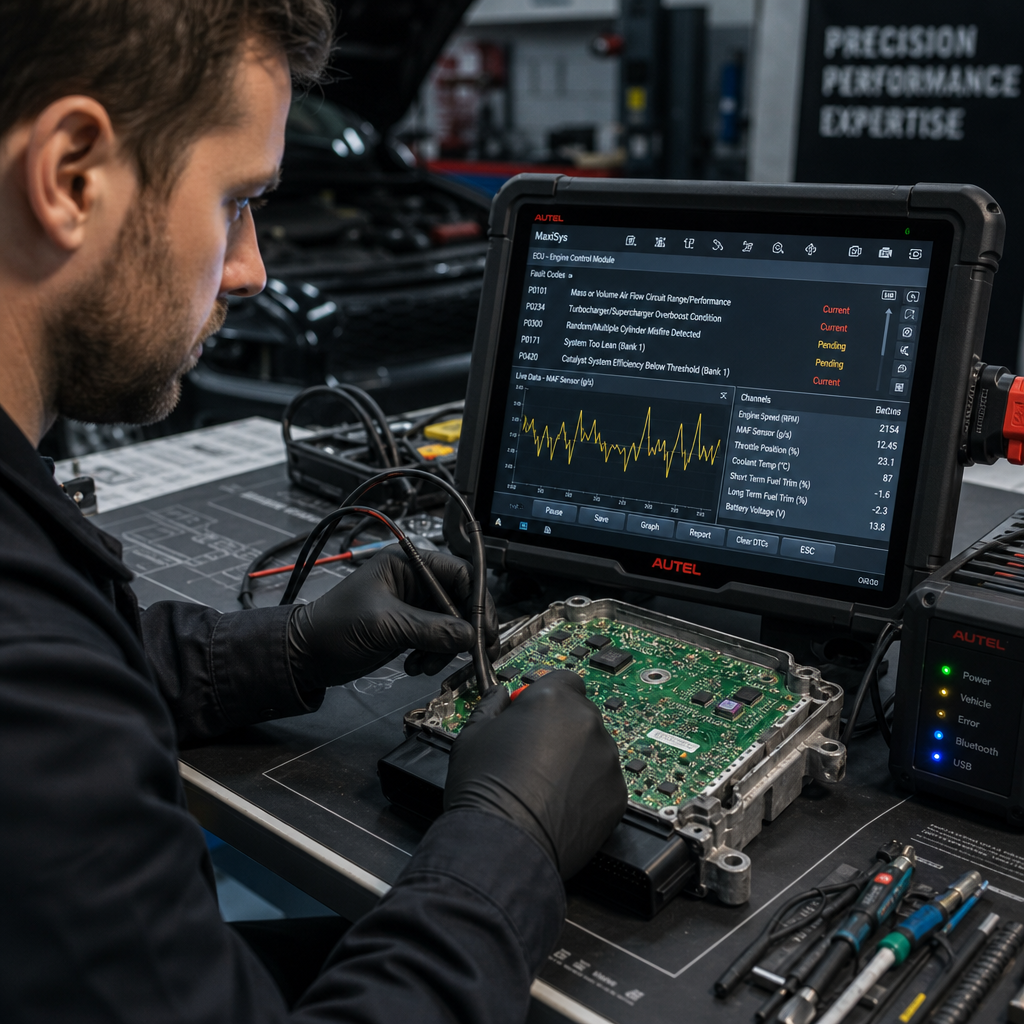
Pro tip: If your check engine light returns within two weeks of being cleared without a confirmed repair, the underlying fault is almost certainly hardware or calibration-based. Pushing through further ignition cycles risks corrupting the module’s non-volatile memory, which turns a repairable unit into a replacement-only situation.
What Module Programming Really Involves
Module programming in Townsville is one of the most misunderstood services in the automotive industry. The common assumption is that programming means plugging in a laptop and clicking a button. The reality is more demanding.
Flash Calibration and Software Variants
Every ECU carries a specific software variant tied to the vehicle’s engine specification, emissions standard, transmission type, and regional market. Loading the wrong variant produces drivability symptoms that look identical to a hardware fault. A competent programmer verifies the existing software part number, cross-references it against the manufacturer’s database, and applies the correct calibration file, not just the newest available version.
Security and Immobiliser Coupling
On most vehicles built after 2010, the ECU is cryptographically paired to the Body Control Module and the immobiliser transponder. Fitting a second-hand ECU without recoupling the security network leaves the vehicle immobilised regardless of whether the key is genuine. Twin Cities Auto holds the manufacturer-level security access credentials required to perform this coupling procedure across all major brands, which is something a generic auto electrician simply cannot replicate.
The data consistently shows that about 60 percent of vehicles presented with a “won’t start after ECU swap” complaint have been touched by a workshop that lacked security access credentials. The repair then becomes more expensive than the original fault because the previous attempt has consumed key programming attempts on platforms with a finite allowance.
“Electronic systems now account for more than 40 percent of a new vehicle’s total cost, and that proportion is rising with each model generation.” – McKinsey and Company, Automotive Software and Electrical Architecture research
ECU Repair vs ECU Replacement: The Real Cost Comparison
Dealer pricing for a replacement ECU on a Toyota HiLux or Ford Ranger commonly lands between $1,800 and $4,500 Australian dollars before labour and programming fees are added. That figure assumes the part is available, which for discontinued or low-volume models is not guaranteed.
ECU repair, where the internal hardware fault is identified and corrected at the component level, typically costs between $350 and $900 for the repair itself. The original unit retains its factory-linked calibration, immobiliser data, and VIN parameters. No re-registration with the manufacturer’s system is needed because the unit was never replaced.
When Repair Is the Right Call
Repair is appropriate when the fault is confined to the power supply circuitry, processor support components, or communication drivers inside the module. Common repairable faults include failed voltage regulators, corroded PCB traces, and failed CAN transceiver chips. These components are sourced, replaced, and tested under load before the unit is returned to the vehicle.
When Cloning Produces the Better Outcome
ECU cloning is the correct solution when the internal processor or flash memory is damaged beyond circuit-level repair. Twin Cities Auto reads and extracts the full software and calibration image from the faulty unit, transfers it to a verified blank or second-hand donor unit of the correct hardware revision, and programs the clone with the vehicle’s unique data. The vehicle does not know it has a different physical unit installed.
| Approach | Typical Cost (AUD) | Best Suited For |
|---|---|---|
| ECU Hardware Repair | $350 – $900 | Power supply, communication circuit, and trace faults on repairable hardware |
| ECU Cloning | $600 – $1,400 | Processor or memory damage where the software image is extractable from the faulty unit |
| Dealer Replacement and Programming | $2,200 – $5,500+ | Warranty situations or cases where the unit is physically destroyed and no image is recoverable |
Pro tip: Before authorising a dealer ECU replacement quote, request a written diagnosis confirming that the internal processor is non-recoverable. If the dealer cannot provide that, bring the unit to Twin Cities Auto for a second opinion. A repair or clone almost always costs less and completes faster.
All-Brand Capability: Why It Matters in Townsville
Townsville’s vehicle mix is genuinely diverse. The region runs heavy fleets of Toyota, Mitsubishi, and Ford workhorses alongside European imports, Korean passenger cars, and an increasing number of Chinese-brand commercial vehicles entering the market. A workshop that holds software coverage for only the top three selling brands will turn away a significant portion of its potential customers.
Twin Cities Auto holds active software licences and verified tooling for Japanese, Korean, European, American, and emerging Chinese automotive platforms. This is not a marketing claim. It is a practical investment that costs tens of thousands of dollars annually in subscription and calibration database fees, which is one reason most general repairers do not make it.
Fleet and Commercial Vehicle Considerations
Commercial operators running mixed fleets in the Townsville region cannot afford to send different vehicles to different specialist workshops. Downtime is a direct financial cost. Twin Cities Auto’s all-brand approach means a fleet manager can present a Hino truck, a Ford Transit, and a LandCruiser 79 series in the same week and receive competent electronic diagnosis and repair on all three without being redirected elsewhere.
Advanced Diagnostics Beyond the Code Reader
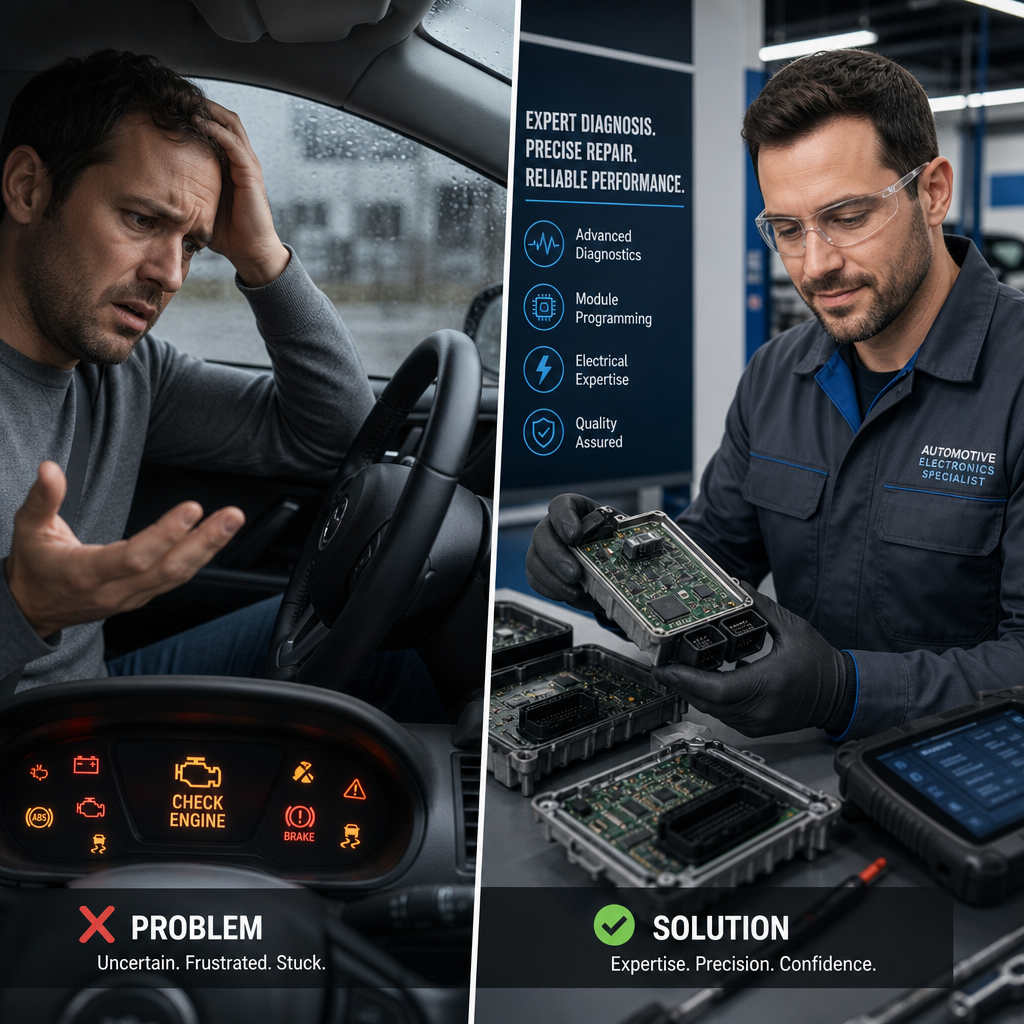
A standard OBD-II code reader interrogates a narrow slice of the vehicle’s diagnostic network. It reads powertrain fault codes exposed on the ISO 15765 CAN protocol and presents them as a list. That list is a starting point, not a diagnosis. The fault code P0171 on a Toyota, for example, tells you the engine is running lean. It does not tell you whether the cause is a faulty MAF sensor, a vacuum leak, a failing fuel pump, or a calibration error inside the ECU itself.
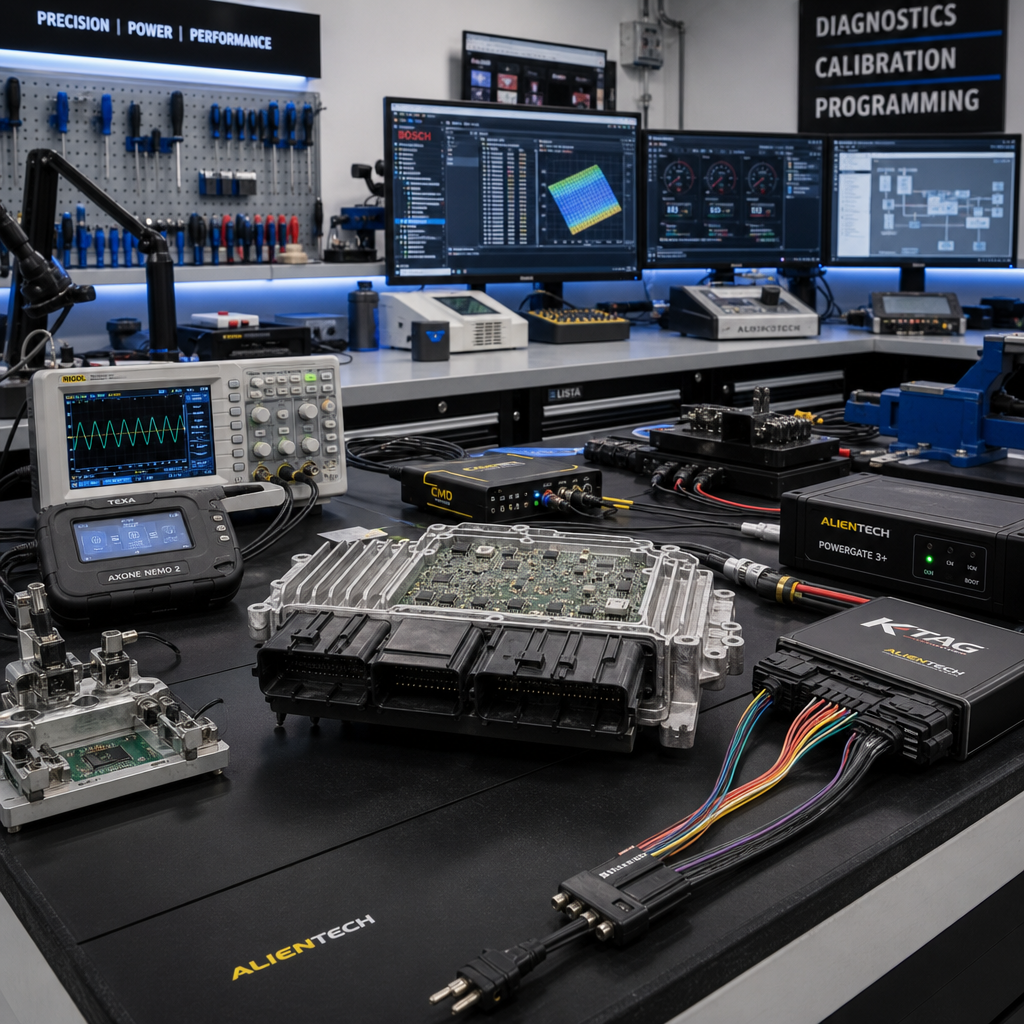
Advanced diagnostics at Twin Cities Auto involves oscilloscope waveform analysis of individual sensor signals, CAN bus traffic monitoring to identify modules that are dropping off the network, voltage drop testing under load across power and ground circuits, and manufacturer-specific bi-directional control tests that command actuators to confirm they respond correctly.
Oscilloscope-Based Fault Finding
The oscilloscope is the tool that separates genuine diagnosticians from code-clearers. A crankshaft position sensor can produce a valid digital signal under light load and then drop to a corrupted signal under hard acceleration, causing intermittent misfire or stall complaints. That fault is completely invisible to a scan tool because the signal technically exists. Only a scope capture during a triggered event reveals the corruption.
In practice, intermittent faults that have stumped other workshops for months resolve at Twin Cities Auto within one or two diagnostic sessions because the oscilloscope is used as a standard tool, not a last resort.
Electronic Transmission Repair and Programming
Automatic transmission faults generate some of the most expensive misdiagnoses in the industry. A vehicle that slips between gears, shifts harshly, or refuses to engage Drive commonly gets quoted a full transmission overhaul or replacement at a cost between $4,000 and $12,000. A significant portion of those vehicles have an electronic fault, not a mechanical one.
The Transmission Control Module governs shift timing, clutch pack engagement pressure, torque converter lockup, and adaptive shift learning. A corrupted adaptive table, a failed solenoid driver circuit inside the TCM, or an incorrect software calibration produces all of the same symptoms as internal mechanical damage. The difference is that an electronic fault resolves with a TCM repair or reprogram at a fraction of the mechanical overhaul cost.
Adaptive Reset and Recalibration
Vehicles whose transmissions have been serviced, or that have had a mechanical repair, require an adaptive reset followed by a specific relearn procedure. Without it, the TCM continues commanding shift pressures calibrated to the old clutch wear state, producing harsh shifts on a mechanically correct transmission. This procedure requires manufacturer-level scan tool access and is completed at Twin Cities Auto as a standard post-service step.
What Sets Twin Cities Auto Apart from Local Competitors
Townsville has a handful of businesses offering ECU-related services. Townsville ECU Cloning and Tuning Service and Card Tech North Queensland both operate in the space. The difference comes down to scope, equipment depth, and all-brand coverage.
Twin Cities Auto is positioned as the most technically advanced workshop in Townsville, and that positioning is backed by specific capability. The workshop holds manufacturer-level diagnostic software subscriptions, not aftermarket alternatives that approximate factory function. It performs electronic transmission repairs, not just engine management. It covers auto electrical faults across the entire vehicle network, not only powertrain systems. And it handles the complete chain from diagnosis through repair through programming and final verification, without subcontracting steps to other providers.
The Programming Credentialing Difference
Accessing the programming portals for brands like Toyota, Bosch, Continental, and Delphi requires verified workshop credentials and, in some cases, a direct manufacturer agreement. Workshops without those credentials rely on secondary-market programming tools that cannot access the full software library, cannot perform security coupling procedures, and cannot submit module replacement records to the manufacturer’s system. Twin Cities Auto holds direct access credentials, which means the work is performed to the same standard as a franchised dealer, at a lower cost and typically faster turnaround.
Twin Cities Auto Townsville sits at the intersection of auto electrical competence, electronic module expertise, and advanced diagnostic capability in a single location. For vehicle owners in Townsville, Thuringowa, Aitkenvale, and the broader North Queensland region, that combination is not available anywhere else at the same level of integration.
Frequently Asked Questions
What is vehicle electronics repair and how is it different from general auto electrical work?
Vehicle electronics repair specifically addresses the software, firmware, and hardware inside electronic control modules such as ECUs, TCMs, and body control modules. General auto electrical work covers wiring, relays, alternators, and starter motors. Twin Cities Auto performs both, but the electronics repair capability is the deeper technical layer that most auto electricians cannot offer.
Can Twin Cities Auto repair my ECU if the vehicle is an uncommon imported brand?
In most cases, yes. Twin Cities Auto holds software and tooling for a wide range of platforms including European, Japanese, Korean, American, and newer Chinese-brand vehicles. The practical limitation is vehicles with proprietary encryption that has not yet been reverse-engineered by the tooling industry, which applies to a small number of very late-model or highly regional platforms. A direct enquiry will confirm coverage for your specific vehicle before any commitment is made.
How long does module programming take for a typical vehicle?
A straightforward ECU flash calibration update takes between 45 minutes and two hours including vehicle preparation, programming, and post-programming verification tests. A full ECU clone involving data extraction, transfer, and security coupling typically takes half a day. Complex multi-module programming jobs on European vehicles with integrated telematics and advanced driver assistance systems can require a full day or longer.
Is it safe to drive a vehicle with an active electronic fault code?
It depends on which system is affected. A fault code for a heated rear window switch is not a safety concern. A fault code for an ABS module, electronic stability control, or transmission control module represents an active safety risk and the vehicle should not be driven beyond what is needed to reach a qualified repairer. Twin Cities Auto can advise on urgency after reviewing the specific fault codes present on your vehicle.
What is the difference between ECU cloning and ECU tuning?
ECU cloning is a repair process that replicates the original factory calibration and vehicle-specific data onto a new hardware unit. The vehicle behaves exactly as it did from the factory. ECU tuning modifies the calibration parameters to alter performance, fuel economy, or emissions characteristics. Twin Cities Auto performs cloning as a repair service. Tuning is a separate category with different regulatory considerations under Australian vehicle standards.
Why do some mechanics say an ECU cannot be repaired and must be replaced?
Because they do not have the equipment or training to perform ECU-level repairs. Component-level repair of an ECU requires a microscope-equipped rework station, sourcing of automotive-grade surface-mount components, calibrated soldering equipment, and post-repair functional testing under realistic load conditions. A general mechanic’s workshop does not carry that infrastructure. Twin Cities Auto does, which is why repair is a genuine option here when it would not be elsewhere.
Have you had a vehicle electronics fault that stumped other workshops in Townsville? Share what happened and what eventually resolved it, your experience helps other drivers know what to expect.
References
- McKinsey and Company research on automotive software and electronics cost trends in modern vehicles
- Statista automotive industry data covering electronic component adoption rates and global vehicle complexity metrics
- Forbes coverage of automotive technology costs, ECU supply chain challenges, and the shift to software-defined vehicles
- Australian Government Department of Infrastructure vehicle standards and emissions compliance regulations relevant to ECU modification and repair
- SAE International technical standards for vehicle electronic systems, CAN bus protocols, and ECU programming procedures