
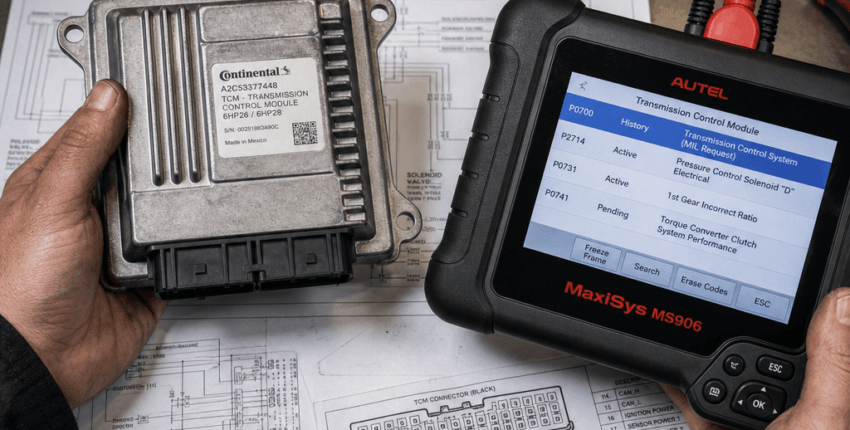
Your car shifts late, shudders between gears, or throws a warning light you have never seen before. Most Townsville drivers assume the worst and brace for a massive bill. The reality is that a large proportion of modern transmission failures are not mechanical at all. They are electronic. The transmission control module, solenoid packs, wiring harnesses, and sensor networks now govern every gear change in your vehicle, and when those systems fail, the symptoms can look identical to catastrophic hardware damage. Knowing the difference is the first step to avoiding an unnecessary rebuild. Electronic transmission repair in Townsville is a specialist service, and this guide tells you exactly what you need to know.
Table of Contents
- Quick Takeaways
- What Is Electronic Transmission Failure and Why Does It Happen
- Warning Signs Townsville Drivers Commonly Miss
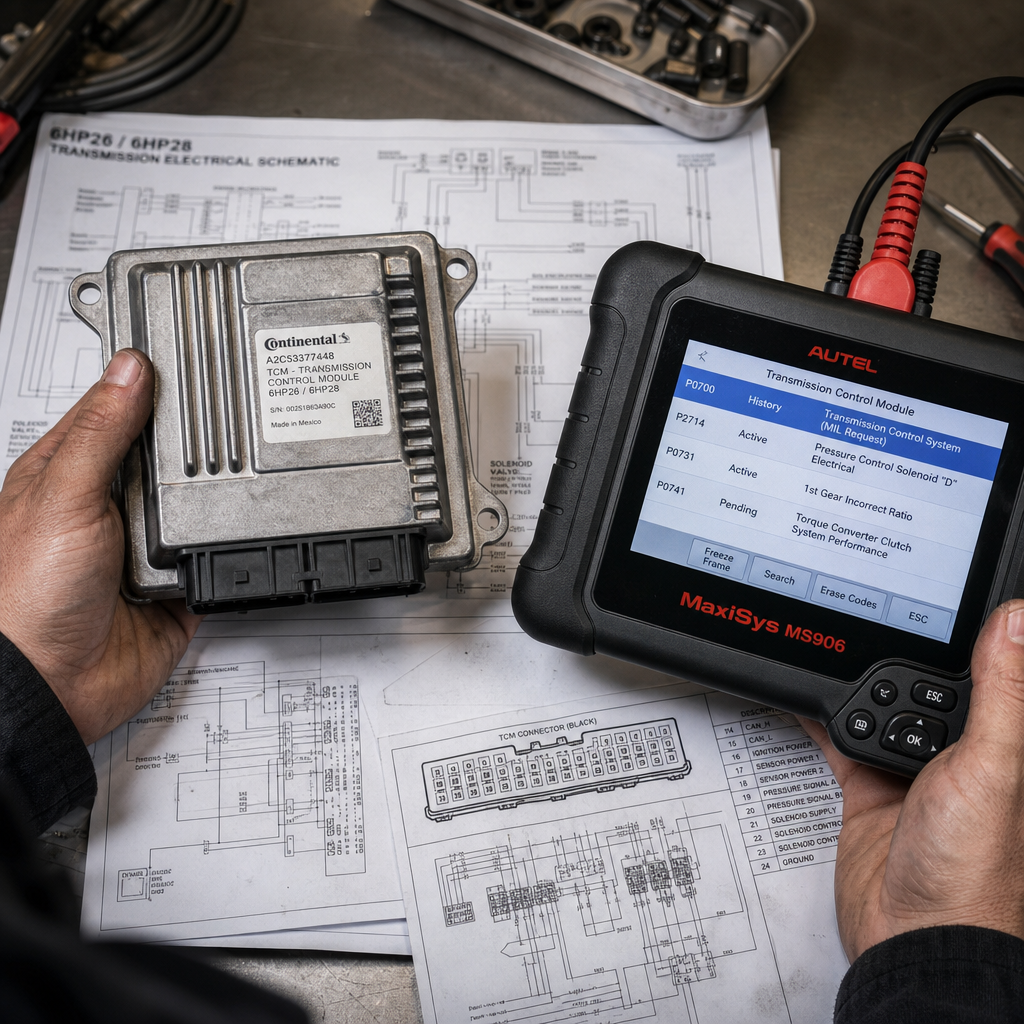
- Transmission Control Module Programming and Cloning Explained
- The Diagnostic Process at an Advanced Workshop
- Repair Options Compared: Programming vs Rebuild vs Replacement
- Why Townsville Drivers Need a Specialist, Not a General Mechanic
- Frequently Asked Questions
- References
Quick Takeaways
| Key Insight | Explanation |
|---|---|
| Most modern transmission faults are electronic first | In vehicles made after 2005, the transmission control module governs every gear shift. A corrupted or failed TCM causes the same symptoms as a worn clutch pack or broken band. |
| Fault codes alone do not give you the full picture | A generic code reader from a parts store will flag a transmission code but cannot tell you whether the fault is in the module, a solenoid, or a wiring harness. Advanced diagnostics are required to isolate the root cause. |
| TCM cloning can save you thousands compared to replacement | When a transmission module fails, cloning the original data to a replacement unit preserves vehicle-specific calibration data and avoids costly dealer reprogramming or full replacement assembly costs. |
| Limp mode is a safety feature, not a death sentence | When the TCM detects an out-of-range signal, it locks the transmission in a single gear to protect the drivetrain. This is recoverable in most cases with correct diagnosis and module repair. |
| Townsville’s climate accelerates electronic component degradation | High humidity, heat cycles above 35 degrees Celsius, and Queensland wet season flooding all accelerate corrosion inside connectors, control modules, and solenoid bodies faster than in southern states. |
| Not every workshop in Townsville has factory-level programming tools | Transmission module programming for European, Asian, and American vehicles requires OEM-level software. Many general workshops outsource this or decline the work entirely. |
| Electronic repairs preserve your existing transmission hardware | If the mechanical components are sound, fixing the electronic fault means no teardown, no replacement seals, and a fraction of the cost and downtime of a full rebuild. |
What Is Electronic Transmission Failure and Why Does It Happen
Every automatic and dual-clutch transmission built in the last two decades relies on a Transmission Control Module, or TCM, to make real-time decisions about when and how to shift gears. The TCM reads signals from wheel speed sensors, throttle position sensors, turbine shaft sensors, and the engine control unit, then commands hydraulic solenoids to execute the shift. When any link in that chain breaks, the transmission behaves erratically.
In practice, electronic transmission failures divide into four categories: module failure (the TCM itself loses memory or develops internal faults), solenoid failure (the electro-hydraulic valves that physically move fluid stop responding correctly), wiring and connector failure (corrosion or heat damage breaks the signal path), and software corruption (incorrect or incomplete programming leaves the module operating on bad data). Each category produces different fault codes and different physical symptoms, which is why generic diagnostics consistently misidentify the problem.
The data consistently shows that Townsville’s subtropical climate is harder on automotive electronics than the conditions most vehicle manufacturers test for in Europe or Japan. Connector corrosion from humidity, thermal cycling between cool nights and 40-degree days, and water intrusion during the wet season all shorten the life of TCMs, solenoid harnesses, and module connectors. A common mistake is for drivers to assume the transmission fluid needs changing when the real fault is a corroded speed sensor connector giving the TCM an intermittent signal.
Warning Signs Townsville Drivers Commonly Miss
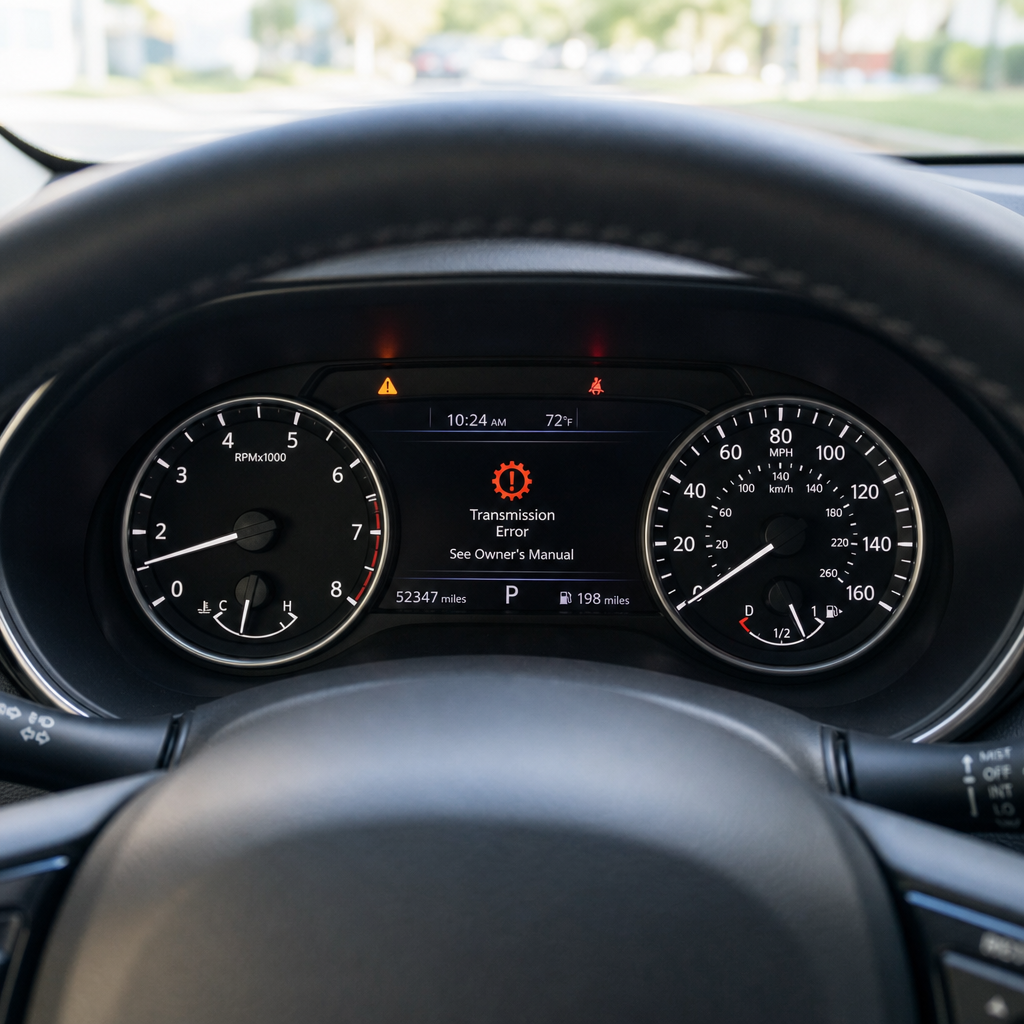
The most obvious sign is a transmission warning light on the dashboard. But electronic transmission faults frequently produce symptoms that drivers attribute to other systems entirely. Late or harsh upshifts, a soft or delayed downshift under hard acceleration, random slipping between gears on the highway, and a complete refusal to engage reverse are all classic electronic TCM symptoms. So is a transmission that suddenly behaves perfectly after a cold start but becomes erratic once the vehicle reaches operating temperature, which points directly to a heat-sensitive solder joint or capacitor inside the module itself.
Limp mode is the symptom that generates the most panic. The vehicle locks into second or third gear and loses power. Drivers often assume the transmission is destroyed. In reality, limp mode is a protective state triggered when the TCM detects a signal it cannot trust. In many cases, a thorough module inspection, a harness repair, or a TCM reprogram resolves limp mode without any mechanical work at all.
Shuddering at highway speeds between 95 and 110 kilometres per hour is another commonly misread symptom. Many drivers assume a worn torque converter or damaged flex plate. The more frequent cause is a torque converter clutch solenoid receiving incorrect commands from a TCM with degraded memory cells. Replacing the solenoid without addressing the module will not fix the root problem.
Pro tip: If your vehicle enters limp mode and then recovers after you switch it off and restart it, do not assume the problem has resolved itself. That pattern almost always means a fault that is getting worse. Get advanced diagnostics done before it strands you on the Bruce Highway.
Transmission Control Module Programming and Cloning Explained
When a TCM needs to be replaced, the new unit cannot simply be bolted in and connected. Modern TCMs are married to the vehicle through a process called module programming, which writes the vehicle identification data, transmission calibration tables, and shift adaptation data into the module’s memory. Without this process, the new TCM either will not communicate with the rest of the vehicle’s network or will shift incorrectly because it is running factory default calibrations rather than the values adapted to your specific drivetrain.
TCM cloning goes one step further. Rather than starting from a blank module with factory defaults, cloning copies the exact data from your original unit, including all the adaptive shift data your transmission has built up over its service life, directly into the replacement module. The result is a vehicle that shifts exactly as it did before the failure, with no relearn period and no risk of incorrect calibration data being applied. For vehicles with proprietary manufacturer software, such as certain Mercedes-Benz 7G-Tronic or ZF 8-speed applications, cloning is often the only practical path to a fully functional repair without a dealer visit.
Which Vehicles Need TCM Programming in Townsville
The short answer is almost all of them. Ford Ranger and Everest models with the 6R80 and 10R80 transmission, Toyota LandCruiser with the AB60 and AC60 units, Holden Colorado with the Aisin 6-speed, Volkswagen and Audi DSG-equipped vehicles, BMW and Mercedes-Benz with ZF-sourced transmissions, and essentially every Hyundai and Kia model sold after 2012 all require OEM-level programming when a TCM is replaced. The programming requirement is not optional. It is built into the design of these systems.
A common mistake is purchasing a second-hand TCM from a wrecker and assuming it will work. A used module carries the VIN data from another vehicle. Without reprogramming or cloning, it will either refuse to communicate with your vehicle’s network or will operate with the wrong calibration data, causing shift quality problems that look identical to the original fault.
The Diagnostic Process at an Advanced Workshop
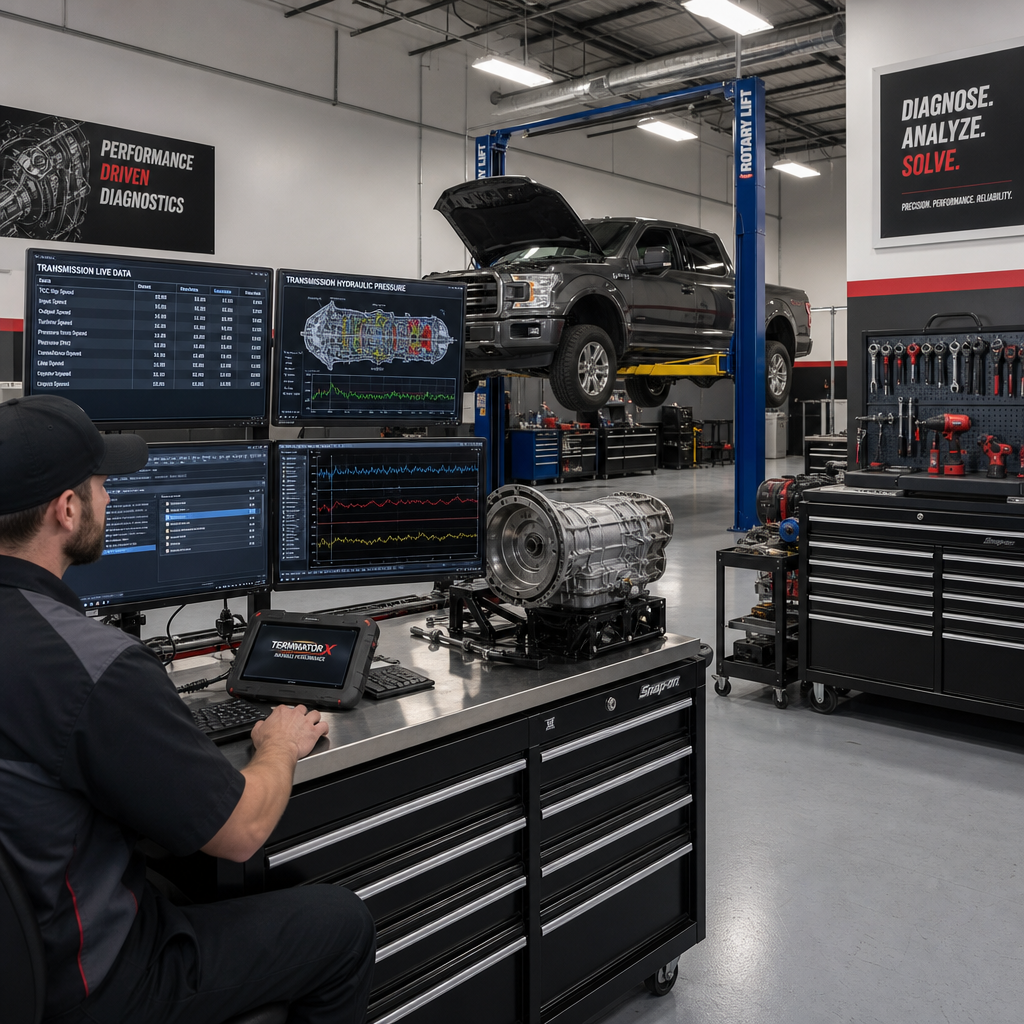
Advanced transmission diagnostics is not the same as plugging in a code reader. The process at a properly equipped workshop starts with a full network scan using OEM-level software that reads every module on the vehicle’s CAN bus, not just the powertrain modules. This reveals stored faults, pending faults, and intermittent faults that a generic scanner will never retrieve. From there, a trained technician looks at live data streams from every sensor feeding the TCM: turbine speed, output speed, line pressure, solenoid duty cycles, and gear ratio actuals versus commanded ratios.
This live data analysis is where the real diagnostic work happens. In practice, a solenoid fault and a TCM internal fault can produce identical fault codes. The difference becomes visible only when you compare solenoid current draw against TCM command signals in real time. A solenoid that is being commanded correctly but not responding points to a mechanical or hydraulic fault. A solenoid that is not receiving the correct command signal points to a TCM or wiring fault. These two faults require completely different repairs, and misidentifying them wastes time and money.
Pro tip: Ask any workshop you contact whether they can show you live transmission data during a road test. If they cannot pull real-time solenoid duty cycle and gear ratio data while the vehicle is moving, they are not equipped to properly diagnose an electronic transmission fault.
“Approximately 40 percent of automatic transmission replacements in the United States are performed when the original unit could have been repaired electronically. The diagnostic step that separates repairable from non-repairable is almost always skipped in favour of a faster, more expensive option.” – sourced from industry repair data compiled by the Automatic Transmission Rebuilders Association (ATRA).
Repair Options Compared: Programming vs Rebuild vs Replacement
Townsville drivers facing a transmission fault have three broad paths available. Understanding what each one actually involves prevents you from being sold a more expensive solution than your vehicle needs.
| Repair Option | Best Suited For | Typical Cost Range and Downtime |
|---|---|---|
| TCM Programming or Cloning | Vehicles with confirmed electronic fault in the control module, corrupted software, or failed TCM with sound mechanical hardware. Common in Ford, Toyota, VW, BMW, Holden, Hyundai, and Kia platforms. | Lower cost compared to rebuild. Turnaround often same day or next day depending on parts availability. No transmission teardown required. |
| Solenoid and Harness Repair | Vehicles where diagnostics confirm a faulty solenoid body, individual solenoid, or corroded wiring harness rather than a module failure. Often combined with a fluid service. | Mid-range cost. Requires partial disassembly of the transmission oil pan. Typically one to two days. Mechanical internals remain untouched. |
| Full Rebuild or Remanufactured Unit | Vehicles where diagnostics confirm mechanical damage inside the transmission: burned clutch packs, failed planetary gears, damaged pump. Electronic systems are replaced as part of the rebuild. | Highest cost. Longest downtime, typically four to seven business days. Necessary when mechanical damage is confirmed, but never the correct first step before proper electronic diagnosis. |
The critical point here is that a rebuild or replacement is only justified when diagnostics confirm mechanical damage. Recommending a rebuild without first isolating the fault electronically is not conservative practice. It is a failure of diagnosis. Twin Cities Auto’s approach is to establish the root cause before recommending any repair pathway, because spending money on a rebuild when a TCM reprogram would have fixed the vehicle is not a good outcome for anyone.
Why Townsville Drivers Need a Specialist, Not a General Mechanic
General automotive workshops are excellent at servicing mechanical systems. Brake pads, suspension components, engine oil, and timing chains are well within their scope. Electronic transmission faults are a different discipline entirely. They require OEM-level diagnostic software, the ability to program and clone control modules, a deep understanding of CAN bus network architecture, and experience reading live transmission data across a wide range of vehicle platforms. Most general workshops in North Queensland do not have all of these capabilities simultaneously.
The workshops that present themselves as specialists in this space in Townsville vary significantly in their actual capability. The difference between a workshop that can read a fault code and a workshop that can perform transmission module programming in Townsville using factory-level software for European, Asian, and American platforms is substantial. Ask specifically whether the workshop has OEM software access for your vehicle’s make, whether they can clone a TCM on-site, and whether they have experience with your specific transmission unit, whether that is a ZF 8HP, an Aisin Warner, a GM 6L80, or a DSG mechatronics unit.
Twin Cities Auto operates as the most advanced workshop in Townsville specifically because electronic module work requires investment in tooling, software subscriptions, and continuous technical training that most workshops choose not to make. The ability to diagnose, repair, and program every major transmission platform across all vehicle brands is not a marketing claim. It is the result of that investment.
As a qualified auto electrician in Townsville, a specialist in this field approaches transmission faults from the electrical and electronic side first, which is exactly where the majority of modern transmission faults originate. This is not the approach of a transmission rebuilder who defaults to teardown, or a general mechanic who clears the code and hopes it stays away.
Frequently Asked Questions
How do I know if my transmission problem is electronic or mechanical?
The most reliable way is advanced diagnostics using OEM-level software. In general, electronic faults tend to produce consistent fault codes, limp mode behaviour, or symptoms that vary with temperature. Mechanical faults tend to produce slipping under load, burning smells, fluid contamination, or metal particles in the transmission fluid. However, symptoms overlap significantly, which is why a proper diagnosis always comes before any repair recommendation.
Can a transmission control module be repaired, or does it always need replacement?
In many cases, TCMs can be repaired at the component level if the failure is due to a faulty capacitor, corroded solder joint, or failed driver circuit on the board. This is a specialised form of electronic repair that requires circuit board level skills. When the module cannot be repaired, cloning the data from the original unit to a replacement is the preferred approach because it preserves all vehicle-specific calibration data without a dealership visit.
How long does transmission module programming take in Townsville?
For most vehicles, the programming process itself takes between 30 minutes and two hours depending on the platform and the depth of calibration required. The total job time, including diagnostics before and verification testing after, is typically a full business day. Complex platforms such as European dual-clutch transmissions with mechatronics unit replacement may take longer if adaptive relearn procedures are required after programming.
Will my vehicle need to go to the dealer for transmission module programming?
Not if you use a workshop with OEM-level programming capability. Many advanced independent workshops, including specialists in Townsville, hold licensed access to factory programming software for the majority of vehicle manufacturers sold in Australia. Dealer visits add cost and wait time without necessarily adding technical capability. The key question to ask is whether the workshop has genuine OEM software access for your specific make, not a generic aftermarket alternative.
What causes a transmission to go into limp mode repeatedly?
Repeated limp mode entry almost always means the root cause has not been addressed. Common triggers include an intermittent speed sensor fault, a solenoid with borderline resistance that fails when hot, a wiring connector with corrosion that breaks contact under vibration, or a TCM with degraded internal memory that stores incorrect calibration data. Clearing the code without diagnosing the fault source will result in limp mode returning, often in more serious form as the underlying fault worsens.
Is it worth repairing an electronic transmission fault on a high-mileage vehicle?
This depends on the condition of the mechanical components inside the transmission, not on odometer reading alone. A vehicle with 250,000 kilometres that has been serviced correctly and has no mechanical wear inside the transmission is an excellent candidate for an electronic repair. The decision changes if diagnostics reveal burned clutch material in the fluid, metallic particles, or internal slippage that confirms hardware damage. The right answer requires a proper diagnosis first, not a kilometre-based assumption.
What is the difference between transmission module cloning and reprogramming?
Reprogramming writes a fresh or updated software calibration to a module, typically starting from factory default values. This is appropriate when the original module is functioning but has corrupted data. Cloning copies the exact data from one module to another at the binary level, preserving all adaptive shift data specific to your vehicle’s drivetrain. Cloning is the preferred method when replacing a failed module because it eliminates the relearn period and ensures the transmission shifts correctly immediately after the repair.
Have you dealt with a transmission warning light or limp mode in your Townsville vehicle? Share what symptoms you experienced and what turned out to be the actual fault, your experience could help another driver make a better decision.
References
- Statista: Australian automotive industry statistics including vehicle population and repair market data
- Forbes: Automotive technology trends covering the shift to electronic vehicle control systems
- Australian Department of Infrastructure: Vehicle safety and roadworthiness standards relevant to transmission and drivetrain systems
- SAE International: Engineering standards and technical research on automatic transmission electronic control systems
- Australian Competition and Consumer Commission: Consumer rights information for automotive repair services in Australia