
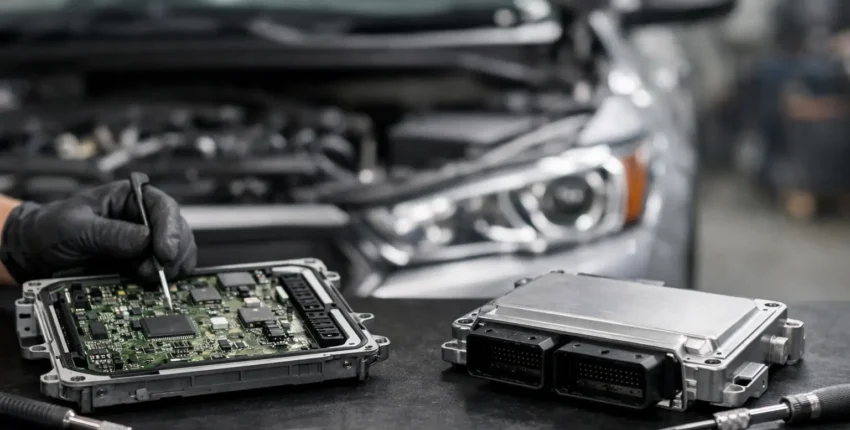
A warning light, no-start fault or engine that suddenly runs poorly can quickly lead to a big question: ECU repair versus replacement. Because the engine control unit is central to how a modern vehicle operates, it is tempting to assume the computer itself has failed. In many cases, though, the ECU is reacting to a fault elsewhere in the vehicle. Proper testing comes before ordering parts.
Your ECU, also called an engine control module or ECM, receives information from sensors and sends instructions to systems such as fuel injection, ignition, turbo control, cooling fans and emissions equipment. When it loses a critical signal, power supply or communication link, the symptoms can look exactly like an internal ECU failure.
For North Queensland drivers who depend on their vehicle for work, school runs or getting out of town, an accurate diagnosis can avoid unnecessary expense and get the car back on the road sooner.
ECU repair versus replacement: start with diagnosis
An ECU should not be repaired or replaced on the basis of a fault code alone. Diagnostic trouble codes are useful clues, but they do not automatically identify the failed part. A code may indicate a circuit problem, for example, while the actual cause is a damaged wire, poor earth, blown fuse, corroded connector or failed sensor.
A technician should first confirm the basics. That includes battery condition and charging voltage, ECU power and earth supplies, fuse integrity, wiring continuity, network communication and sensor reference voltages. On late-model vehicles, the diagnostic process may also include reading live data, checking manufacturer test procedures and communicating with multiple control modules.
This matters because modern vehicles can share information across several computers. A fault in the body control module, immobiliser, CAN network or even water-damaged wiring may prevent the engine ECU from operating as intended. Replacing the engine ECU without finding that underlying fault can leave the same problem in place – and risk damaging the replacement unit.
At Twin Cities Automotive, dealer-level scan equipment and electrical testing are used to establish what the vehicle is actually doing before any repair work proceeds. Customers are given a clear repair recommendation and asked for approval before work is carried out.
When an ECU can be repaired
Repair can be a sensible option when testing confirms an internal ECU fault but the unit is otherwise suitable for restoration. Depending on the module and fault, specialists may be able to repair damaged circuit-board components, restore failed power circuits, address internal communication faults or repair issues caused by heat, vibration or moisture.
A repair is often worth considering when a replacement ECU is difficult to source, particularly on an older vehicle or some imported and European models. Retaining the original ECU can also reduce coding complications because its original vehicle identity and immobiliser data may remain intact. That said, not every unit can be repaired reliably, and a repair should only be recommended where there is a clear prospect of a lasting result.
The condition of the vehicle around the ECU still matters. If moisture has entered through a leaking windscreen, blocked plenum drain, damaged seal or flood exposure, that source must be fixed as well. If it is not, even a successfully repaired ECU may be exposed to the same damaging conditions again.
Signs that point towards a repairable fault
An ECU repair may be possible where a vehicle has confirmed internal driver faults, no communication from the ECU despite correct power and earth supplies, or a known issue within that module type. Intermittent faults can be more involved. Heat, vibration and humidity can cause a connection to fail only under certain conditions, so testing may need to be repeated while monitoring live data and electrical signals.
The key is evidence. A good workshop can explain what has been tested, what has been ruled out and why an ECU fault is the most likely conclusion.
When replacement is the better option
Replacement is usually the better path when the ECU has severe internal damage, extensive corrosion, unrecoverable software faults or no viable repair option. It can also make sense where a quality new, remanufactured or tested replacement unit is readily available and carries an appropriate warranty.
However, fitting the physical module is only one part of the job. Many replacement ECUs need programming or coding to match the vehicle. This can involve writing the correct calibration, entering the vehicle identification information, pairing the ECU with the immobiliser and programming keys or fobs. Some vehicles require additional security access or online manufacturer functions before they will start.
A used ECU can appear to be the cheapest choice, but it can create problems if its part number, hardware version or software is not compatible. It may also be locked to the donor vehicle’s immobiliser system. In some situations, a used unit can be cloned or programmed; in others, it cannot. Buying a module before diagnosis and compatibility checks can turn a manageable repair into an expensive delay.
The real cost is more than the ECU price
Comparing ECU repair and replacement only by the price of the module can be misleading. The full cost may include diagnostic time, removal and refitting, programming, security coding, key matching, software updates and rectifying the original cause of failure.
For example, an ECU that has failed because of a shorted ignition coil, actuator or wiring circuit may fail again if that circuit is not repaired first. Likewise, a low battery voltage or charging fault can cause multiple warning lights and communication errors that resemble computer trouble. Paying for a replacement ECU before checking those foundations is rarely good value.
The best option depends on the vehicle, the confirmed fault, parts availability and what will provide dependable long-term operation. A repair may preserve the original module and reduce coding requirements. A replacement may provide greater certainty where the old unit has extensive damage. Neither is automatically the right answer for every car.
What a proper ECU repair plan should include
Once testing identifies the fault, the repair plan should be straightforward. You should know whether the ECU itself has been confirmed faulty, what evidence supports that finding, whether repair is possible and what replacement options are available. You should also be told if programming, key coding or further electrical repairs are required.
After the work is completed, the vehicle should be checked for correct starting, communication, warning-light operation and fault-code return. Where relevant, a road test and scan of live data can confirm that the engine management system is responding normally under real operating conditions.
Be cautious of anyone who promises to fix an ECU issue simply by clearing the warning light or replacing a module without testing its power supplies and connected circuits. A warning light is a symptom, not a diagnosis.
Act early when electronic faults appear
Some ECU-related faults start as occasional hard starting, intermittent stalling, a check-engine light or erratic gauges. Leaving them can lead to a breakdown at the least convenient time, particularly when heat, rain or a weak battery makes an existing electrical issue worse. Early diagnosis is usually less disruptive than waiting for a no-start condition.
If your vehicle has an unresolved warning light, recurring electrical fault or has already been assessed without a clear answer, ask for diagnosis that follows the evidence. The right repair is not always the cheapest part on day one – it is the one that fixes the cause and keeps your car dependable afterwards.