
A warning light that comes and goes, a battery that keeps going flat or a car that will not start can all point to the same issue: an electrical fault that needs proper testing. Auto electrical fault finding is not about replacing the part that looks most likely. It is a structured process of tracing the cause, confirming the repair and making sure the problem does not return when you least need it.
For Townsville and North Queensland motorists, electrical problems can be more than an inconvenience. Your vehicle may be needed for school runs, work sites, long highway trips or towing. Modern cars rely on dozens of control units, sensors, wiring circuits and communications systems, so a small fault can affect far more than one feature.
What is auto electrical fault finding?
Auto electrical fault finding is the process of identifying why an electrical or electronic system is not operating as it should. This may involve a no-start condition, an illuminated warning light, an intermittent fault, a charging issue, an airbag warning, a malfunctioning central locking system or an engine that is not running correctly.
The key word is identifying. A fault code from a scan tool is useful, but it is not always the answer. A code may tell a technician which system has detected an abnormal reading. It does not automatically prove that the sensor, control module or component named in the code has failed.
For example, an engine fault code may relate to a sensor signal, but the real cause could be damaged wiring, corrosion in a connector, a poor earth, low battery voltage or a separate issue affecting communication between vehicle computers. Replacing parts before testing can become expensive quickly and may leave the original problem unresolved.
Why modern vehicles need a methodical diagnosis
Older vehicles had relatively simple electrical systems. A battery, alternator, starter motor, lights and a few switches made up much of the electrical work. Late-model vehicles, including European cars, hybrids and electric vehicles, are considerably more complex.
A typical vehicle now has computer-controlled braking, safety restraint systems, fuel injection, climate control, steering assistance, keyless entry, infotainment and driver-assist features. These systems share information across networks. When voltage drops, wiring is damaged or a module fails to communicate, the result can be several unrelated-looking warning lights at once.
That is why a quick visual inspection or basic code read is sometimes enough, but not always. Straightforward issues such as a worn battery or failed globe can be resolved efficiently. Intermittent faults, network communication errors and faults that only appear when the engine is hot, wet or under load require more detailed testing.
A reliable diagnosis protects you from paying for unnecessary components. It also helps prevent a temporary repair from masking a more serious issue, particularly where braking, airbag, charging or engine-management systems are involved.
Common signs your vehicle has an electrical fault
Electrical faults do not always present as a complete breakdown. Often, the early signs are subtle and easy to dismiss. You may notice slower cranking in the morning, headlights that dim at idle, a clock or radio that resets, a burning smell near the battery, or accessories that work only occasionally.
Other concerns need prompt attention. These include an airbag, ABS, battery or engine warning light; repeated flat batteries; a vehicle that cuts out; central locking that stops responding; or a key and fob that will not communicate with the car. If a warning light remains on, the vehicle has recorded a condition that should be checked rather than ignored.
Heat, vibration, moisture and age all take a toll on wiring and connectors. In North Queensland, high temperatures can place added pressure on batteries and charging systems. A battery may test adequately one day but struggle when the electrical load rises or when the engine is started after sitting in the heat.
How a technician traces the real cause
Professional auto electrical fault finding begins with the details you provide. Knowing when the issue occurs can save valuable diagnostic time. Does the warning light appear only after rain? Does the car fail to start after a short trip? Has a battery been replaced recently? Did the problem begin after towing, an accessory installation or body repairs?
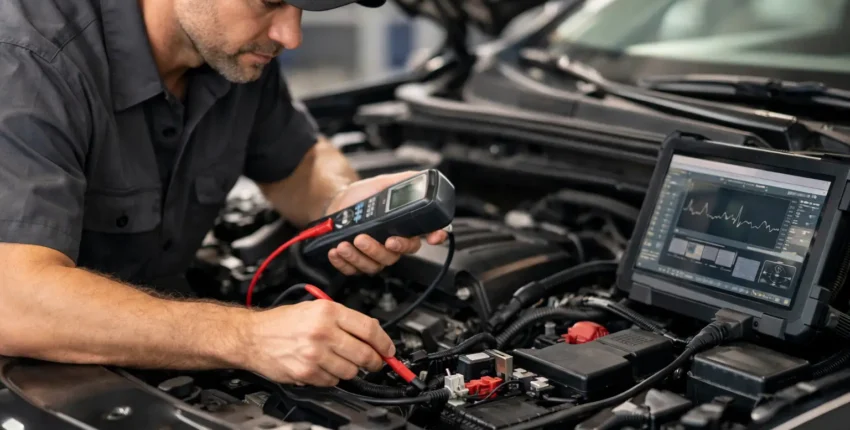
The technician then checks the vehicle’s condition and carries out targeted tests. Depending on the fault, this can include a battery and charging-system assessment, inspection of fuses and wiring, voltage-drop testing, checking earth connections, reviewing live scan data and communicating with individual control modules using dealer-level diagnostic equipment.
Live data is particularly useful because it shows what the vehicle is seeing in real time. Rather than assuming a sensor is faulty, a technician can compare its readings against expected operating conditions. Circuit testing can then confirm whether the issue is within the component itself, the wiring supplying it or the computer interpreting its signal.
For intermittent faults, testing may need to reproduce the conditions that trigger the problem. That could mean checking the vehicle hot and cold, moving a wiring loom carefully to reveal an internal break, or monitoring the system while it is driven. This work can take longer than a simple repair, but it is often what separates an accurate repair plan from guesswork.
Fault codes are a starting point, not a shopping list
Many drivers have had a scan performed elsewhere and been told they need a particular sensor or module. Sometimes that assessment is correct. However, fault codes should be interpreted alongside physical testing and the vehicle’s history.
Consider a low-voltage code. It may be caused by an ageing battery, but it could also result from a charging fault, a loose terminal, excess current draw while parked or a poor connection in a main power supply. Replacing the battery alone may restore operation briefly without solving why it went flat.
The same applies to complex electronic components. ECU replacement, programming, key coding and airbag repairs require the correct equipment and procedures. In some cases, the original unit can be repaired or the cause of the communication issue can be addressed without replacing a costly module. In others, replacement and coding are necessary. The right option depends on confirmed test results, vehicle specifications and parts availability.
When a flat battery is more than a battery problem
A flat battery is one of the most common electrical complaints, yet the battery is not always at fault. If it has reached the end of its service life, replacement may be all that is needed. If a sound battery is repeatedly discharged, the vehicle needs further investigation.
The alternator may not be charging correctly, a connection may be loose or corroded, or an electrical circuit may be drawing power after the vehicle is switched off. This is known as a parasitic draw. Common causes can include an accessory that does not shut down, a sticking relay, a module that remains awake or damaged wiring.
These faults can be difficult to find because the vehicle may behave normally while it is running. Accurate testing involves measuring the draw at rest, allowing systems time to power down and isolating circuits carefully. Pulling fuses at random can disrupt vehicle systems and may not identify the root cause.
What you can do before booking your car in
You do not need to diagnose the problem yourself, but a few observations can help. Make a note of warning lights, unusual messages on the dash, when the fault occurs and whether the vehicle has recently had repairs, accessories or a new battery fitted. If it is safe to do so, take a photo of warning messages before they disappear.
Avoid repeatedly jump-starting a vehicle without finding out why it is flat. Voltage spikes and ongoing low voltage can create additional faults in computer-controlled vehicles. Likewise, do not continue driving with an airbag, ABS or charging warning light simply because the car appears to run normally.
If you have fitted an aftermarket accessory such as driving lights, a dash camera, trailer wiring or a dual-battery system, mention it when booking. This does not mean the accessory is necessarily the cause, but it gives the technician a clearer starting point.
Clear diagnosis leads to better repair decisions
The value of proper diagnosis is confidence. Before repair work begins, you should understand what has been found, what needs attention and why. At Twin Cities Automotive, diagnostic testing is used to build an accurate repair recommendation, with customer approval required before service work proceeds.
That approach matters when a vehicle has a difficult or recurring fault. It gives you a practical path forward rather than a series of parts replaced in hope. Whether the issue is a warning light, failed charging system, key programming concern or a complex ECU-related fault, the goal is the same: identify the cause and repair it properly.
If your vehicle is trying to tell you something through a warning light, flat battery or intermittent starting issue, acting early can often prevent a roadside breakdown and keep a smaller electrical problem from becoming a larger repair.