
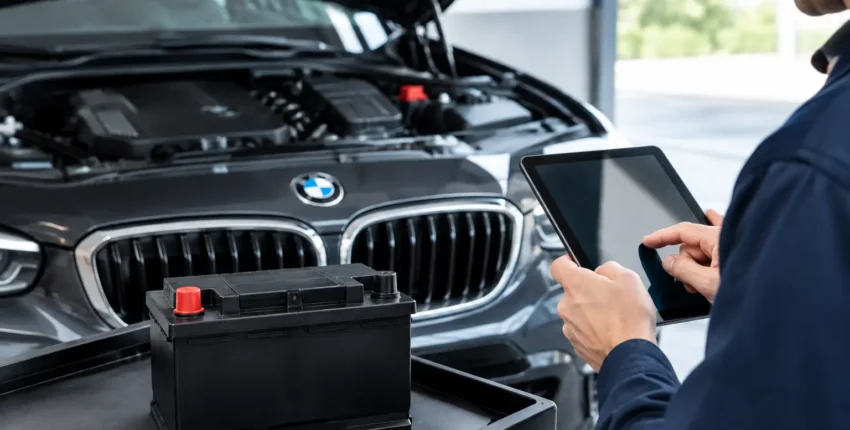
A new battery can make a BMW start strongly again, but fitting it is only part of the job. This BMW battery registration guide explains the electronic step that many owners miss: telling the vehicle a new battery has been installed so its charging system can look after it correctly.
Modern BMWs monitor battery condition closely. They do not simply run the alternator at one fixed output as many older vehicles did. If the vehicle still believes it has an old, worn battery after replacement, it may continue using a charging strategy designed for a battery nearing the end of its life. That can shorten the life of the new battery and create avoidable electrical faults.
What BMW battery registration actually does
Battery registration resets the vehicle’s battery age and usage history within the battery management system. On many BMW models, the Intelligent Battery Sensor, usually fitted around the negative battery terminal, tracks battery performance, charging behaviour and electrical load.
When a new battery is registered, the vehicle adjusts its charging strategy for a fresh battery. This helps it manage alternator output, regenerative charging where fitted, stop-start operation and the many electrical systems that rely on stable voltage.
Registration is not the same as clearing a warning light. It is a service procedure carried out with suitable diagnostic equipment that communicates with the BMW’s control modules. The job is relatively quick when everything is straightforward, but it matters because the vehicle’s electrical system is making decisions based on battery condition every time you drive.
Why a BMW needs registration after battery replacement
BMW batteries work hard, particularly in vehicles with stop-start, comfort access, heated seats, electric tailgates, multiple control modules and long periods of short-trip driving. North Queensland heat can add further strain. High under-bonnet temperatures, frequent air-conditioning use and battery age can all affect performance.
An unregistered replacement battery will not necessarily cause an immediate no-start condition. The car may appear completely normal for days or weeks. The issue is that its charging system may overcharge or undercharge the new battery because it is still compensating for the characteristics of the old one.
Over time, that can contribute to a reduced battery lifespan, stop-start faults, low-voltage warning messages or intermittent electrical behaviour. BMWs are sensitive to voltage changes, so a weak or incorrectly managed battery can sometimes produce unrelated-looking warnings for systems such as ABS, airbags, transmission control or parking assistance.
That does not mean every warning light is caused by the battery. Proper diagnosis is still essential. A fault code may be a result of low voltage, or it may identify a separate fault that needs attention. Guessing and replacing parts can become expensive quickly.
Registration versus battery coding
The terms battery registration and battery coding are often used together, but they are not always the same procedure.
If the replacement battery is the same type, capacity and specification as the original, registration may be all that is required. For example, replacing an AGM battery with another AGM battery of the same amp-hour rating will generally involve registering the new battery.
If the battery type or capacity changes, the vehicle may also need coding so the charging strategy matches the new specification. A change from a conventional flooded lead-acid battery to an AGM battery, or a change in amp-hour capacity, should not be treated as a simple swap-and-register job.
Using the wrong battery setting can affect battery charging and service life. It can also cause stop-start performance issues. The correct approach depends on the specific BMW model, year, battery fitted from factory and the replacement battery’s specifications.
Choosing the correct replacement battery
Battery fitment is about more than whether it physically fits in the boot or under the bonnet. BMW batteries vary in size, terminal layout, capacity, cold-cranking rating and battery technology. Many later models use AGM batteries because they are designed to cope with repeated cycling and higher electrical demand.
A quality replacement should match the vehicle’s requirements. Fitting a lower-capacity battery to save money can be false economy if it cannot support the electrical load the vehicle was designed to carry. On the other hand, installing a larger battery without checking whether coding is required can also create problems.
Before fitting a battery, confirm the battery type, amp-hour rating and physical size. Check the battery tray, hold-down clamp and terminals for corrosion or damage, and inspect the battery sensor and wiring. A new battery cannot solve a charging fault, excessive parasitic drain or poor cable connection.
Can you register a BMW battery yourself?
Some aftermarket scan tools and BMW-specific diagnostic apps can perform battery registration on compatible models. For an experienced owner with the correct tool, a suitable replacement battery and a clear understanding of the vehicle’s requirements, it can be possible to complete the task correctly.
There are trade-offs, though. Low-cost tools do not always provide full access to every BMW model or module, and menu options can be unclear. Selecting the wrong battery type or capacity can be worse than not registering it at all. There is also the risk of missing the real reason the previous battery failed.
If the old battery went flat after only a short service life, do not assume the battery itself was the only problem. A failing alternator, battery sensor issue, voltage-drop fault, accessory left connected, module that does not go to sleep, or water entry can all cause repeat battery failures.
For many owners, professional registration makes sense because the battery replacement can be checked alongside the vehicle’s charging system and fault memory. That gives a clearer answer than simply fitting a battery and hoping the warning messages stay away.
Signs your BMW may have a battery or charging issue
A slow crank is an obvious sign, but late-model BMWs often give earlier warnings. You may notice stop-start becoming unavailable, the clock or personalised settings resetting, central locking behaving inconsistently, a battery discharge message appearing on the screen, or warning lights that come and go.
Electrical faults may be more noticeable after the car has been parked for several days, following a very short drive, or during periods of heavy air-conditioner use. A battery can test acceptably at rest yet still struggle under load or fail to hold voltage once the vehicle is switched off.
It is also worth acting promptly if a battery warning appears after replacement. The warning could indicate that registration was missed, but it could also point to a charging-system fault. Diagnostic testing is the sensible next step rather than repeatedly jump-starting the vehicle.
What a proper battery replacement visit should include
A careful BMW battery service starts by confirming the battery condition and charging voltage, then checking whether the vehicle has stored low-voltage or energy-management faults. The correct battery can then be fitted securely, with terminal connections and battery sensor wiring inspected as part of the process.
Once installed, the new battery is registered using suitable diagnostic equipment. Where the battery specification has changed, the correct coding should be considered for that model. A final system check helps confirm that the vehicle recognises the replacement and that no relevant fault messages remain.
At Twin Cities Automotive, this type of work is approached as an electrical diagnosis as well as a battery replacement. Dealer-level diagnostics can identify whether the issue is simply an ageing battery or whether another fault is affecting charging and battery drain. Any recommended repair work should be explained clearly and approved before it proceeds.
A practical note for Townsville BMW owners
Heat is hard on batteries, and vehicles that do mostly short local trips may not have enough running time to fully recover the energy used during starting and air-conditioning operation. If your BMW is approaching the usual battery replacement age, testing it before it fails can prevent an inconvenient no-start at home, work or on a weekend away.
Keep the battery specification on record, especially if it has been replaced before. That information makes future diagnosis faster and helps ensure any replacement is registered and coded correctly. A properly managed battery is a small detail that protects the larger, more complex electrical systems your BMW depends on.