
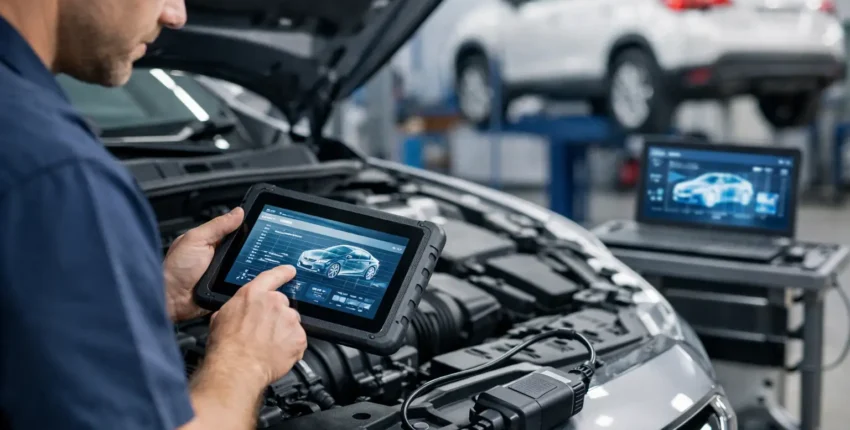
A warning light that disappears, a car that only misbehaves on a hot afternoon, or a battery that goes flat after sitting overnight can turn a simple drive across Townsville into a frustrating guessing game. Advanced vehicle diagnostics Townsville motorists can access is about replacing that guesswork with evidence. It identifies what the vehicle is reporting, tests the systems involved and narrows the fault down before repair work is approved.
Modern vehicles are controlled by dozens of computers, sensors, wiring circuits and electronic modules. That is good news when everything is working properly, but it also means a fault is not always visible under the bonnet. A professional diagnostic process helps protect you from replacing parts that are not actually causing the problem.
What advanced vehicle diagnostics actually involve
A diagnostic scan is a useful starting point, but it is not the same as a complete diagnosis. When a warning light comes on, the vehicle stores a fault code that points technicians towards the affected system. It may relate to an engine sensor, ABS brake circuit, airbag component, transmission control module or communications issue between computers.
The code does not automatically tell anyone which part to replace. For example, a code indicating a low signal from a sensor may be caused by the sensor itself, damaged wiring, corrosion in a connector, a poor earth, a power-supply issue or a problem in the control unit receiving the signal. Replacing the first part named by a code reader may make no difference at all.
Advanced diagnostics combine dealer-level scan equipment with vehicle-specific wiring information, live data readings, electrical testing and practical mechanical knowledge. Technicians compare what the vehicle should be doing with what it is actually doing. They can test circuits under load, check signal patterns, assess module communication and, where required, carry out programming or coding after a repair.
That process takes more skill than plugging in a scanner, yet it can save considerable time and expense when the fault is intermittent or has already defeated a basic inspection.
Why Townsville conditions can expose vehicle faults
Townsville vehicles work hard. Heat, humidity, heavy rain, dust, short urban trips and long North Queensland highway runs all place different demands on electrical and mechanical systems. Battery terminals and electrical connectors can corrode. Cooling systems and air-conditioning systems face constant pressure. Heat can reveal weak sensors, failing ignition components and aged wiring that behaves normally when cold.
A battery can still start the car while delivering unstable voltage that confuses sensitive electronics. Similarly, a small water entry point can create an intermittent electrical fault that only appears after rain or washing the vehicle. These are the sorts of issues that need testing rather than assumptions.
The vehicle’s make, age and symptoms matter too. A late-model European car may require specialist scan tools and coding procedures to communicate properly with its modules. An older diesel ute may have a fault involving fuel pressure, wiring, glow systems or emissions controls. Electric and hybrid vehicles add high-voltage safety requirements, battery cooling systems and sophisticated control electronics. The right diagnostic approach depends on the vehicle in front of the technician.
When a warning light needs more than a quick reset
It is tempting to clear a warning light and see whether it returns. Sometimes a one-off low-voltage event or loose fuel cap may trigger a code that does not come back. But clearing the code does not repair the underlying issue, and it can remove useful information needed to diagnose it properly.
A check-engine light deserves prompt attention, particularly if the car is running roughly, using more fuel, losing power or producing unusual exhaust smoke. A flashing engine light can indicate a misfire severe enough to damage the catalytic converter, so it should not be ignored. ABS, brake, airbag and steering warnings are also safety-related. The vehicle may still drive, but a safety system may not operate as intended in an emergency.
Transmission warnings, delayed gear changes, limp mode or a message telling you to stop safely can point to anything from a sensor or wiring fault to a fluid, mechanical or control-module concern. The earlier the condition is assessed, the better the chance of avoiding secondary damage.
Useful details to provide at booking
Clear information makes diagnosis more efficient. Let the workshop know whether the fault occurs when the engine is cold or hot, after rain, at highway speed, while braking, when using the air-conditioner or only after the vehicle has been parked. Mention recent battery replacement, repairs, collision damage, accessory fitting or rodent activity as well.
If a warning message appears, take a photo before it disappears. Do not worry if you cannot explain the problem in technical terms. Describing exactly what you see, hear or feel is often more useful than trying to name the part you think has failed.
The diagnostic process should be clear and accountable
A proper diagnosis begins with listening to the customer and confirming the symptoms where possible. The technician then checks the vehicle’s stored codes, live data and basic electrical condition before following a logical test path. This may include checking fuses, power and earth supplies, connectors, wiring continuity, sensor readings, pressure values or mechanical operation.
Some faults are resolved quickly. Others take longer because they occur only under particular conditions. An intermittent no-start, for instance, may require the vehicle to be tested when the failure is active. A workshop should explain when this is the case rather than promise certainty before sufficient evidence is available.
Once the cause is identified, the repair recommendation should be specific: what has failed, why it has failed where that can be established, what work is required and what the likely cost will be. If programming, calibration or an adaptation procedure is needed after fitting a component, that should also be included. Customer approval before service work proceeds keeps the decision in your hands.
Advanced vehicle diagnostics in Townsville can prevent repeat repairs
The biggest benefit of thorough testing is not simply turning off a dashboard light. It is finding the fault accurately enough to repair the right issue the first time. That can reduce repeat visits, avoid unnecessary parts and give you greater confidence when your vehicle is needed for school runs, work travel, towing or a trip out of town.
This matters particularly when a vehicle has been to more than one workshop without a lasting answer. A recurring fault is not always proof that previous repairs were poor. Vehicles can have more than one issue, or one underlying electrical problem can produce several unrelated-looking symptoms. However, repeated part replacement without a documented test result is rarely the most economical path forward.
Advanced diagnostic capability is also valuable after a repair. Fault codes can be rechecked, systems can be road-tested and electronic modules can be confirmed as communicating correctly. For brakes, airbags, engine management and transmission systems, that final verification is part of a dependable repair, not an optional extra.
Choosing a workshop for complex electronic faults
Ask whether the workshop has the equipment and training to work on your vehicle, especially if it is late-model, European, hybrid or electric. It is reasonable to ask how diagnostic time is charged and whether the workshop will contact you with findings before proceeding with repairs. Straight answers are a good sign.
Experience across mechanical, electrical and electronic systems is equally useful. A warning light may originate in an electronic circuit, but the real cause could be a vacuum leak, cooling problem, worn component or contaminated fluid. The strongest diagnostic work considers the whole vehicle rather than treating the scan tool as the final authority.
Twin Cities Automotive combines family-owned local service with specialist computer diagnostics, electrical testing and repair capability for complex vehicle faults. The aim is straightforward: provide a clear repair plan based on proper testing, then proceed only with your approval.
If your car is sending mixed signals, do not wait for a small warning to become a roadside problem. Recording the symptoms and arranging an informed inspection gives you the best chance of a repair that makes sense, lasts and gets you confidently back on the road.