
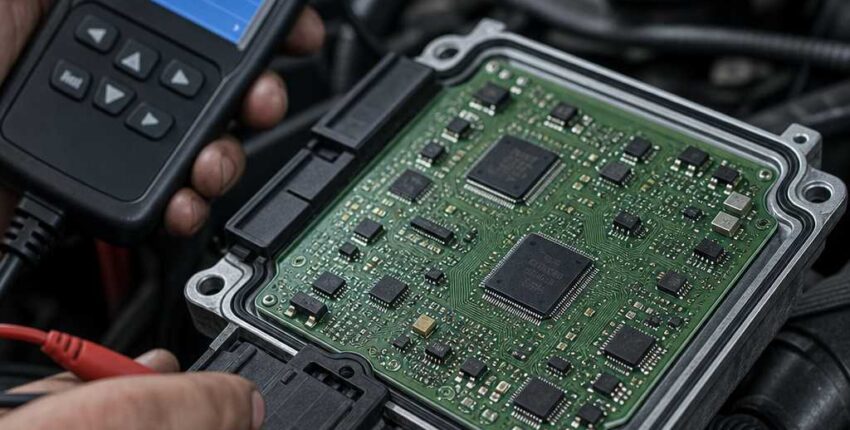
Most Townsville drivers arrive at a workshop after a failed start, a transmission that refuses to shift, or a dealer quote that made their eyes water. Someone online mentions ECU cloning. Someone else says programming is what they actually need. The two terms get used interchangeably, and that confusion costs people time, money, and sometimes a perfectly good control module. ECU cloning Townsville searches are climbing, yet fewer than one in five workshops in North Queensland have the equipment and training to do the job correctly. This guide explains exactly what each service involves, when each one applies, and what separates a capable workshop from one that is guessing.
Table of Contents
- Quick Takeaways
- What Is ECU Cloning and When Do You Actually Need It
- What Is ECU Programming and How It Differs
- When Cloning Is the Right Call for Your Vehicle
- When Programming Is the Right Call
- Cloning vs Programming vs ECU Repair: A Direct Comparison
- How to Choose the Right Workshop in Townsville
- Module Programming Beyond the ECU
- Frequently Asked Questions
- References
Quick Takeaways
| Key Insight | Explanation |
|---|---|
| Cloning copies existing data; programming writes new data | ECU cloning transfers the exact software and calibration from a donor unit to a replacement. Programming rewrites or updates the software to match a new vehicle configuration or specification. |
| Cloning is the correct choice when the original ECU is physically damaged | If the processor is dead but data can be recovered, cloning to a new unit avoids dealer reprogramming costs and VIN-lock issues that would otherwise require dealership intervention. |
| Programming requires a running, communicating module | You cannot program an ECU that will not respond over the OBD network. If communication is lost, cloning at chip level is the only viable path forward. |
| Not all workshops have the hardware for chip-level cloning | Bench-level ECU work requires special programmers , or similar platforms combined with micro soldering competency. Most general repairers in Townsville do not carry this equipment. |
| Transmission control modules follow the same rules as engine ECUs | Electronic transmissions store adaptive shift data and VIN bindings. A replacement TCM must be either cloned from the original or programmed to the vehicle, otherwise drivability faults will appear immediately. |
| A wrong approach can brick a module permanently | Attempting OBD programming on a unit that needed chip-level cloning can corrupt flash memory beyond recovery. The mistake is irreversible and forces a full ECU replacement. |
| Twin Cities Auto is currently the most advanced facility for this work in Townsville | With chip-level programmers, full OEM-level scan tools, and hands-on ECU repair capability, the workshop handles cases that dealers and general repairers turn away. |
What Is ECU Cloning and When Do You Actually Need It
ECU cloning is the process of reading the complete binary data from an existing ECU memory chip, including the calibration tables, immobiliser codes, and VIN binding, and writing that exact data onto a replacement unit. The result is a module that the vehicle treats as its original. No dealer visit is required. No key relearning is required in most cases. The vehicle does not know a swap occurred.
In practice, cloning is the correct solution in three specific scenarios. The first is physical ECU failure where the processor or power circuitry has died but the memory chip survived. The second is water or fire damage where the board cannot be repaired cost-effectively. The third is a situation where a second-hand ECU is being fitted and must carry the original vehicle’s data rather than the donor vehicle’s configuration.
The data consistently shows that water ingress is the leading cause of ECU failures across North Queensland, where humidity and wet season flooding push moisture into engine bays and firewall cavities at a rate that drivers in southern states rarely experience. This makes ECU cloning Townsville a far more common need here than the national average would suggest.
Pro tip: Before assuming your ECU is dead, ask the workshop to confirm whether the memory chip is intact. A chip that reads successfully means cloning is viable. A chip that returns no data means the data is gone and you are looking at a fresh programming job instead.


What Is ECU Programming and How It Differs
ECU programming refers to writing new or updated software to a module that is functionally intact and capable of communicating with diagnostic tools. This includes flashing a replacement ECU to match a specific vehicle, updating factory calibrations to fix known bugs, and configuring modules after a hardware installation such as a new diesel injector set or a turbo upgrade.
Programming assumes the module is alive. The tool connects over the OBD port or directly to the module’s communication pins, establishes a handshake, and transfers the software file. The process requires manufacturer-level access or a subscription to platforms like Autel, Bosch ESI, or OEM factory tools. For vehicles still covered by manufacturer subscriptions, a workshop needs current access credentials, not just the hardware.
A common mistake is sending a damaged ECU to a programmer who attempts OBD-level reprogramming when the module cannot respond. The tool hangs mid-flash, the write cycle corrupts the existing data, and the ECU is now unreadable. That unit is typically unrecoverable. The correct diagnostic step is always to test communication first and choose the method based on what the module can actually do, not what the workshop’s tools happen to support.
“The single biggest error in ECU work is applying an OBD programming procedure to a unit that needed chip-level intervention. Once you start writing to a module that cannot sustain a stable connection, you are rolling dice with an irreplaceable piece of hardware.” – Twin Cities Auto, advanced diagnostics and module programming, Townsville
When Cloning Is the Right Call for Your Vehicle
Your Original ECU Is Dead or Damaged
If the workshop’s scan tool shows no communication on the OBD network and bench testing confirms no power or processor response, the only way to preserve your vehicle’s immobiliser pairing and calibration data is to read the memory chip directly. If the chip is intact, cloning to a new or second-hand compatible unit restores the vehicle without touching the dealer’s key learning system.
You Have Sourced a Second-Hand Replacement ECU
Fitting a second-hand ECU without cloning your original data onto it will result in an immobiliser conflict. The replacement unit carries the previous vehicle’s VIN and key codes. The vehicle will crank but not start, or in some cases will not crank at all. Cloning your original data onto the replacement unit solves this without requiring new keys or a dealer immobiliser reset, which on some European platforms costs more than the ECU itself.
Dealer Programming Is Not Available or Is Prohibitively Expensive
For vehicles outside manufacturer support windows, discontinued platforms, or grey import vehicles where Australian dealer tools do not carry the correct calibration file, cloning from the original is often the only technical path available. This is particularly common with Japanese domestic market vehicles, older European diesels, and American-specification vehicles brought into Queensland.
Pro tip: Always ask the workshop whether they read the chip before quoting. A workshop quoting ECU cloning without confirming the chip is readable is quoting on an assumption, not a diagnosis.
When Programming Is the Right Call
Programming is the correct choice when a new OEM ECU has been sourced and needs to be configured to the vehicle. New modules ship from the factory in a virgin or unconfigured state. They will not start the vehicle without programming because the immobiliser system does not recognise them. The workshop must write the vehicle’s VIN, key data, and calibration onto the new unit using either OEM factory software or a compatible aftermarket platform.
Programming also applies when a software update from the manufacturer is available to address a known fault. Australian Consumer Law protections, particularly sections covering goods that fail to meet an acceptable quality standard, have pushed some manufacturers to release calibration updates that address fuelling, emissions, or transmission shift quality issues. A workshop with current OEM access can apply those updates directly.
ECU programming Townsville is also the correct service after replacing a sensor or actuator that requires the control module to relearn its baseline values. Throttle body replacements on many European platforms, for example, require a throttle adaptation procedure that only completes correctly when run through an OEM-level scan tool, not a generic code reader.

Cloning vs Programming vs ECU Repair: A Direct Comparison
Understanding where each service fits helps you ask the right questions before approving any work. The table below covers the three main service paths for a failed or non-communicating ECU.
| Service Type | When It Applies | What the Workshop Needs |
|---|---|---|
| ECU Cloning | Original ECU is physically dead or damaged but memory chip is intact. Second-hand ECU needs original data. Dealer programming unavailable. | Chip-level programmer, micro soldering capability, binary file management software, compatible blank or donor ECU. |
| ECU Programming | New OEM ECU fitted to vehicle. Software update available. Module communicates but needs VIN binding or configuration after hardware change. | OEM-level diagnostic platform or manufacturer subscription access, stable OBD connection, correct calibration file for vehicle VIN and build date. |
| ECU Repair | ECU has failed due to a repairable hardware fault such as a blown driver transistor, failed capacitor, or corroded connector. Chip data is intact. Replacing the ECU entirely is not cost-effective. | Component-level electronics repair skills, schematic access, reflow or replacement of surface-mount components, post-repair bench testing before reinstallation. |
How to Choose the Right Workshop in Townsville
The gap between workshops that understand ECU work at a component level and those that use the term loosely to describe a basic scan tool flash is significant. In Townsville, the options narrow quickly when the job requires actual chip-level capability. Here is what to ask before handing over your vehicle.
Ask Specifically What Equipment They Use
A workshop performing genuine chip-level cloning will be able to name their programmer. Special programming tools, and similar platforms are industry-standard tools for this work. If the response is vague or the technician cannot explain the process, the workshop is not equipped for anything beyond basic OBD flashing.
Ask Whether They Repair ECUs or Only Replace Them
ECU repair North Queensland is a niche that requires electronics knowledge beyond automotive diagnostics. A workshop that repairs circuit boards, not just reflashes them, has a fundamentally different skill set. Twin Cities Auto performs component-level ECU repairs, which means a failed driver stage or a water-damaged power supply circuit can be fixed without replacing the entire module. That matters when the module carries irreplaceable calibration data or when new units are on a 12-week back order from an overseas supplier.
Ask About Their Range of Supported Vehicles
Some competitors in North Queensland focus on a narrow range of popular platforms. A workshop that handles all brands, including European, Japanese, Korean, American, and Australian-market vehicles, needs a broader tool investment and more diverse technical knowledge. For grey imports, fleet vehicles, or older classics, the supported vehicle range is the first qualification to check.
Twin Cities Auto handles all brands across the Townsville and broader North Queensland market. This is not a marketing claim. It reflects the tool investment required to hold current calibration access for platforms ranging from Toyota and Ford to BMW, Mercedes-Benz, Hyundai, and Isuzu commercial vehicles.
Module Programming Beyond the ECU
Module programming Townsville covers far more than the engine control unit. Modern vehicles contain between 30 and 150 individual control modules depending on specification. Each module communicates over a vehicle network, and most are either VIN-bound or carry adaptive data that must be preserved or correctly configured when the module is replaced.
Transmission Control Modules
Electronic transmissions store shift adaptation data built up over thousands of kilometres of driving. A replacement TCM that has not been cloned or programmed to the vehicle will produce immediate drivability complaints, including harsh shifts, incorrect gear selection, and in some cases a limp mode that prevents normal driving. The adaptive data in the original module is as important as the calibration file itself.
Body Control Modules and Gateway Modules
BCMs control everything from central locking and window operation to instrument cluster communication and immobiliser relay functions. On many platforms, replacing a BCM without correct programming results in a vehicle that will not start, will not unlock, or will throw persistent fault codes across every system on the network. Gateway modules on late-model European vehicles add an additional layer, requiring security access tokens before any programming can begin.
ADAS and Safety System Modules
Adaptive cruise, autonomous emergency braking, and lane-keep modules require calibration after any replacement, not just programming. Calibration involves physical target alignment in a controlled environment. A module that has been programmed but not calibrated will either deactivate the system or, more dangerously, operate with incorrect reference data. This is an area where car computer cloning Australia-wide is seeing rapid growth in demand as ADAS-equipped vehicles age out of factory warranty.
Frequently Asked Questions
Can any workshop in Townsville clone an ECU?
No. ECU cloning at chip level requires specific hardware programmers, the technical knowledge to operate them without corrupting the module, and in many cases soldering skills to physically access the memory chip. Most general automotive workshops in Townsville do not carry this equipment. You need a specialist facility with documented capability, not just a workshop that has watched a tutorial and owns a basic OBD tool.
How long does ECU cloning take compared to programming?
A straightforward cloning job on a common platform typically takes between two and four hours including bench work, data transfer, and reinstallation. Programming a new OEM ECU over OBD can be completed in under an hour if the calibration file is available and the network connection is stable. The time difference matters less than choosing the correct method. A fast but incorrect approach produces a result that requires the whole job to be redone.
Will cloning my ECU affect my vehicle’s warranty?
If the vehicle is still under a manufacturer warranty, any modification to the ECU software can affect that coverage. Australian Consumer Law provides independent protections against defects regardless of whether a workshop has modified the software, but manufacturer warranties are contractual and may include terms about non-OEM calibrations. For vehicles outside the factory warranty period, cloning carries no warranty implications beyond what the repairing workshop provides.
What happens if an ECU cloning job goes wrong?
If the binary file is incorrectly written, the module can be bricked, meaning it holds corrupted data and cannot be read or written again without specialist recovery tools. A competent workshop will always back up the original data before writing anything, verify the read before proceeding, and bench test the cloned unit before returning it to the vehicle. Ask any workshop you engage whether they perform a verified backup before writing. If they cannot confirm this step, do not proceed.
Is ECU cloning legal in Australia?
Cloning your own vehicle’s ECU data onto a compatible replacement unit for the purpose of maintaining roadworthiness is legal. Cloning ECU data to defeat an immobiliser on a stolen vehicle is a criminal offence under Queensland and Commonwealth law. The service performed by legitimate workshops like Twin Cities Auto involves the vehicle owner’s own data transferred to their own replacement hardware. This is a repair service, not a circumvention of security systems.
What is the difference between ECU cloning and ECU tuning?
Cloning copies existing data from one unit to another without modifying the calibration. Tuning modifies the calibration intentionally to alter performance parameters such as fuel maps, boost pressure, or ignition timing. The two services use some of the same hardware but serve completely different purposes. A cloned ECU produces a vehicle that behaves identically to how it did before the fault. A tuned ECU is deliberately changed from factory specification. Twin Cities Auto offers both services and will advise which is appropriate based on the vehicle’s condition and the owner’s goals.
If you have recently dealt with an ECU failure or been quoted for module programming work in Townsville or anywhere in North Queensland, share your experience below so other drivers know what to expect from the process.
We would love your feedback and any insights you would share with others. What perspective would you add?
References
- Australian Competition and Consumer Commission – consumer rights for automotive repairs and parts under Australian Consumer Law
- Australian Department of Infrastructure, Transport, Regional Development, Communications and the Arts – vehicle standards and type approval regulations for electronic systems
- SAE International – technical standards and research publications covering automotive electronic control systems and module communication protocols
- Statista – global automotive electronics market data and growth statistics for vehicle control module technology
- Forbes – industry reporting on automotive technology costs, repair market trends, and the growing complexity of vehicle electronic systems