
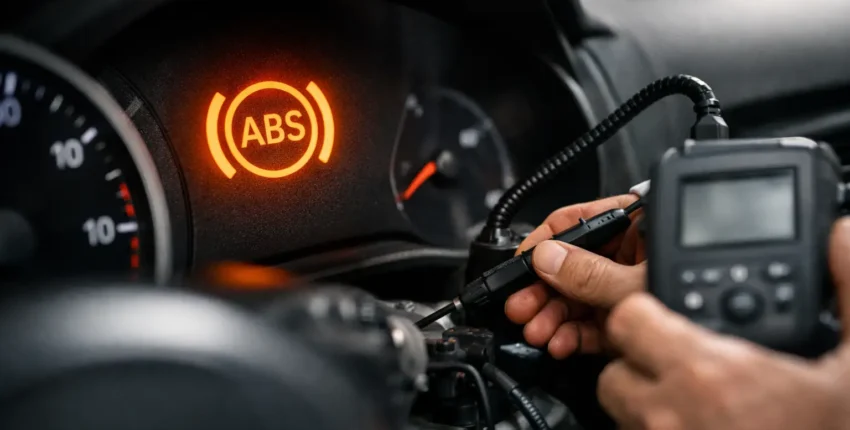
An amber ABS light is easy to ignore when the car still seems to stop normally. But ABS brake fault diagnosis is not just about clearing a warning light. It is about finding out whether your vehicle can still manage wheel lock-up in a sudden stop, on a wet road or when avoiding an unexpected hazard.
For Townsville and North Queensland motorists, that matters. Heat, heavy rain, rough roads and water crossings can all expose weaknesses in wheel sensors, wiring and electrical connections. The right repair starts with proper testing, not assumptions and not replacing parts until the light goes away.
What the ABS warning light is telling you
ABS stands for anti-lock braking system. During hard braking, it monitors the speed of each wheel and rapidly adjusts brake pressure if one or more wheels are about to lock. This helps the driver retain steering control while braking hard.
When the ABS warning light stays on after starting the vehicle, the system has detected a fault and has usually switched off its anti-lock function as a precaution. On many vehicles, conventional braking remains available. However, you may no longer have ABS assistance in an emergency, and related systems such as traction control, stability control or hill-start assistance may also be affected.
A red brake warning light is different. It can point to low brake fluid, a hydraulic issue, the park brake being applied, or another fault requiring immediate attention. If a red brake light appears with a changed brake pedal feel, reduced braking performance, fluid leaking near a wheel, or a vehicle pulling under brakes, do not keep driving. Arrange for the vehicle to be checked promptly.
ABS brake fault diagnosis needs more than a code scan
A scan tool is an essential starting point, particularly on late-model and European vehicles, but a fault code is not a repair instruction. A code may identify an implausible wheel-speed signal, for example. That does not automatically mean the wheel-speed sensor itself has failed.
The cause could be a damaged sensor cable, loose connector, corroded terminals, a broken reluctor ring, excessive wheel-bearing play, incorrect tyre sizes, low battery voltage or a fault within the ABS control module. Replacing a sensor without checking these possibilities can waste time and money, then leave the warning light on.
A thorough diagnosis combines the vehicle’s stored fault information with live data and physical inspection. Technicians compare wheel-speed readings while the vehicle is moving, assess wiring integrity, inspect connector condition and check the sensor’s position and signal. They also look for clues from related warning lights and the vehicle’s repair history.
This approach matters because modern cars are connected systems. An ABS issue can appear alongside steering-angle sensor, engine, transmission or body-control faults. The job is to identify the original cause rather than chase every warning light separately.
Why intermittent ABS faults can be difficult
Some faults only occur under certain conditions. A warning light might appear after a long drive, following heavy rain, over corrugations, or when the vehicle is first started in the morning. Heat can affect electronic components, while vibration can expose a wire that has broken inside its insulation.
Intermittent faults need patience and the right equipment. Stored data can show when the fault occurred and under what conditions. Live testing may reveal a wheel-speed signal dropping out for a fraction of a second, even though the sensor looks fine during a visual inspection. Clearing the code without confirming the cause may provide a short-term result, but it rarely solves the problem.
Common causes of ABS warning lights
Wheel-speed sensors and their wiring are among the most common causes. These sensors operate in a harsh location near the wheels, where they are exposed to road grime, water, brake dust and impact damage. A cable can also be stretched or rubbed through after suspension work, a wheel-bearing replacement or off-road use.
Wheel bearings can create ABS faults too. On many vehicles, the wheel-speed encoder is built into the bearing or hub assembly. If the wrong bearing is fitted, the encoder is damaged, or the bearing develops excessive movement, the ABS module may receive an unreliable signal.
Electrical issues are another regular cause, particularly on vehicles with ageing batteries, charging faults or previous accessory installations. Modern control modules need stable voltage. Low voltage during cranking, poor earth connections or water in a connector can trigger faults that appear unrelated at first glance.
Less commonly, the ABS hydraulic module or electronic control unit can fail internally. These components are expensive and often need programming or coding after replacement. That is exactly why they should be tested carefully before a replacement is approved.
What you can safely check before booking in
There are a few useful observations you can make without attempting a repair. Note whether the ABS light comes on immediately at start-up or only after driving. Pay attention to whether traction control or stability-control lights appear at the same time. If the warning followed tyre, brake, suspension or wheel-bearing work, mention that when booking.
Check that all tyres are correctly inflated and are a matching size specified for the vehicle. Significant differences in rolling diameter can confuse some systems. You can also look for obvious damage around the wheels, but avoid unplugging sensors or spraying cleaners into electrical connectors. Modern brake and electronic systems are easily made worse by well-meaning repairs.
Do not rely on an online code reader as a final answer. Basic readers often cannot access manufacturer-specific ABS data, and they cannot test wiring, hydraulic operation or sensor output. A code can help describe the symptom, but it does not replace diagnosis.
The repair plan should be clear before work starts
Once testing identifies the fault, the repair should match the evidence. It may be as straightforward as repairing a damaged wire or replacing a failed wheel-speed sensor. In other cases, a wheel bearing, wiring harness section, connector, ABS module or control unit may be required.
The trade-off is usually between the lowest immediate cost and the repair most likely to last. A poor-quality sensor or unsuitable wheel bearing may cost less upfront but can create repeat faults, particularly in demanding North Queensland conditions. Where parts are difficult to source, the workshop should explain the options, expected timing and any implications before work begins.
After repair, the system should be retested. This includes clearing verified fault codes, confirming the warning light remains off and checking live wheel-speed data where appropriate. If module programming, coding or calibration is required, it must be completed correctly so the vehicle’s safety systems communicate as intended.
At Twin Cities Automotive, ABS concerns are assessed with dealer-level diagnostic equipment and practical mechanical inspection. You receive an explanation of the fault and recommended repair before work proceeds, so there is no guesswork and no repair work without your approval.
When an ABS fault should not wait
An amber ABS light does not always mean the vehicle must be stopped immediately, but it should not be put off for weeks. Your normal brakes may still operate, yet the vehicle may behave differently in a panic stop or on a slippery surface. Allow more braking distance and avoid assuming traction or stability control will step in.
Treat the issue as urgent if the red brake warning light is also on, the brake pedal is soft or sinking, braking performance has changed, the vehicle pulls strongly, there is a grinding noise, or brake fluid is low. These signs may indicate a problem beyond the ABS system.
A warning light is your vehicle asking for attention before a small electrical or sensor fault becomes a bigger safety concern. Booking a proper diagnosis early gives you a clearer repair plan, helps avoid unnecessary parts replacement and keeps your car ready for the roads you rely on every day.