
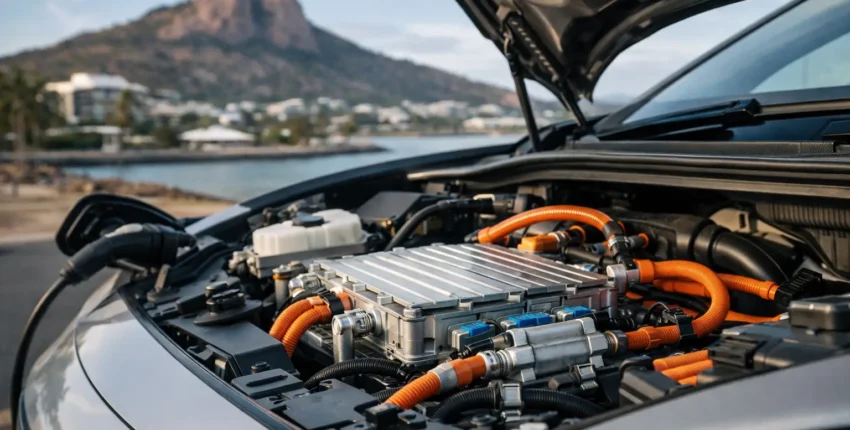
A parked EV in Townsville can face cabin and road-surface temperatures far above the number shown in the weather forecast. That heat places real demands on electric vehicle battery cooling, particularly after highway driving, repeated fast charging or sitting in the sun. The cooling system is not an optional comfort feature – it is a carefully managed part of the vehicle that helps protect battery performance, charging speed and long-term battery condition.
For most drivers, the practical message is simple: an EV that displays a battery, cooling or power-system warning should be assessed properly rather than driven until the message disappears. Modern EVs use multiple control modules, sensors and high-voltage safety systems. A clear diagnosis can separate a minor cooling-system issue from a fault that needs prompt attention.
Why electric vehicle battery cooling matters
Lithium-ion battery cells work best within a controlled temperature range. When the battery is too cold, it may accept charge slowly and provide less available power. When it is too hot, the vehicle may reduce performance, limit rapid charging or run fans and pumps more frequently to bring temperatures back under control.
Heat also affects battery ageing. Every battery is designed with protective limits, and the vehicle will usually intervene before serious damage occurs. However, regularly operating in extreme heat or continuing to drive with a cooling fault can place extra strain on the thermal management system and may contribute to reduced battery health over time.
That does not mean a North Queensland EV is unsuitable for local conditions. Manufacturers build thermal controls into modern electric vehicles for exactly this reason. It does mean the cooling system deserves the same attention as the engine cooling system in a petrol or diesel vehicle – especially when warning lights, reduced charging performance or unusual noises appear.
How EV battery cooling systems work
The arrangement varies by make and model, but many EVs use a liquid cooling circuit. Coolant moves through plates or channels near the battery pack, collecting heat from the cells. An electric pump circulates that coolant through a radiator, heat exchanger or chiller, where the heat can be released.
In some vehicles, the air-conditioning system plays a role as well. A refrigerant chiller can cool the battery coolant when outside air alone is not enough, such as during fast charging or a very hot afternoon. Other models may use separate coolant circuits for the battery, electric motor, inverter and cabin heating or cooling. The software controls pumps, valves, fans and compressors according to sensor readings across the vehicle.
This is why EV cooling faults are not always obvious from a quick visual check. A coolant level may appear acceptable while a pump is not responding, a valve is sticking, a temperature sensor is reporting incorrect data or a control module has stored a fault code. Conversely, a fan running after the vehicle is switched off may simply be normal heat management.
Cooling is about charging as well as driving
Rapid charging creates heat within the battery. The faster the charge rate, the more closely the vehicle needs to manage cell temperatures. If the battery is already hot after a long drive, the car may temporarily slow the charging rate while it cools the pack.
A slower charge is not automatically a fault. Battery temperature, charger capability, state of charge and the vehicle’s own protection strategy all affect the result. But if charging has become consistently slow, the vehicle reports a thermal-management warning, or the air-conditioning system is not operating as expected, it is worth arranging a diagnostic check.
Signs your EV may need a cooling-system inspection
A warning message on the dash is the clearest reason to book in. Messages can refer to the high-voltage battery, electric drive system, cooling system, power reduction or limited charging. Do not assume that clearing the message through the screen has fixed the underlying cause.
Other signs can be less direct. You may notice reduced acceleration on hot days, a rapid charger delivering lower-than-usual speed, persistent fan operation, unfamiliar pump or compressor noises, coolant visible beneath the vehicle, or an air-conditioner that no longer cools the cabin effectively. Some of these symptoms can have unrelated causes, which is precisely why a proper fault-code scan and system test matter.
If you see smoke, smell burning, receive a red high-voltage warning, or suspect damage under the vehicle after striking road debris, stop safely and follow the manufacturer’s instructions. Do not touch orange high-voltage cables, battery housings or any fluid around a damaged battery pack. Arrange professional assistance rather than attempting a roadside repair.
What a proper diagnosis should involve
EV cooling diagnosis starts with the vehicle’s stored fault information, not guesswork. Dealer-level scan equipment can identify which module logged the fault and show live readings such as battery temperatures, pump commands, valve positions and cooling-system pressure where applicable. Those readings help a technician determine whether the issue is electrical, mechanical, refrigerant-related or software-related.
The next steps depend on the vehicle and fault. They may include inspecting coolant condition and levels, pressure-testing the low-temperature cooling circuit, testing electric pumps and cooling fans, checking wiring and connectors, assessing the air-conditioning system, or carrying out manufacturer-approved programming and calibration. With some models, a replacement component must be coded or commissioned before the vehicle will operate correctly.
This process matters because EV components are expensive and closely integrated. Replacing a pump, sensor or air-conditioning part without confirming the cause can waste time and money. Accurate testing supports a repair plan based on evidence, with the work explained and approved before repairs proceed.
At Twin Cities Automotive, advanced electrical diagnosis is approached this way: identify the fault, explain what the test results mean in plain language, then discuss the repair options before any service work begins. It is a sensible approach for late-model EVs as well as the complex petrol, diesel and hybrid vehicles seen across Townsville.
EV cooling maintenance in North Queensland
EVs generally need less routine mechanical maintenance than conventional vehicles, but they are not maintenance-free. The manufacturer’s service schedule remains the starting point, including any specified coolant inspections or replacement intervals. Battery coolant is not always the same as conventional engine coolant, and mixing products or using an incorrect fluid can cause corrosion, poor cooling performance or damage to seals and components.
Avoid treating battery coolant as a DIY top-up job. On many models, access is restricted and the correct filling procedure may require specific equipment to remove air from the circuit. A low level can also indicate a leak, so topping it up without finding the source is not a lasting repair.
There are a few sensible habits that can reduce unnecessary thermal load. When practical, park under cover, use scheduled cabin pre-conditioning while the vehicle is plugged in, and allow the vehicle time to manage battery temperature after a long, hot run before expecting maximum rapid-charging speeds. These habits help, but they cannot compensate for a system fault.
Is the cabin air-conditioner connected to the battery cooling system?
Sometimes, yes. In many EVs, the same high-voltage air-conditioning compressor and refrigerant circuit can assist with battery cooling through a chiller. That is why an air-conditioning complaint can occasionally be linked to battery thermal management.
However, poor cabin cooling does not always mean the battery is overheating, and a battery cooling warning does not always mean the air-conditioner needs regassing. The circuits, sensors and controls vary considerably between manufacturers. Testing the complete system is safer than making assumptions based on one symptom.
Can you drive with a battery cooling warning?
It depends on the warning and the vehicle’s instructions. A minor advisory may allow limited driving to a workshop, while a red warning, severe power reduction or instruction to stop requires immediate action. The vehicle may protect itself by limiting performance or charging, but relying on those safeguards is not a repair strategy.
If the vehicle is still driveable, avoid heavy loads, aggressive acceleration, towing and repeated rapid charging until it has been inspected. Keep the manufacturer’s handbook guidance in mind and arrange diagnosis as soon as possible.
Heat is part of life in North Queensland, but repeated EV warnings do not have to become part of owning one. Early, informed diagnosis gives you the best chance of protecting the battery system, avoiding unnecessary parts replacement and getting back to reliable daily driving.