
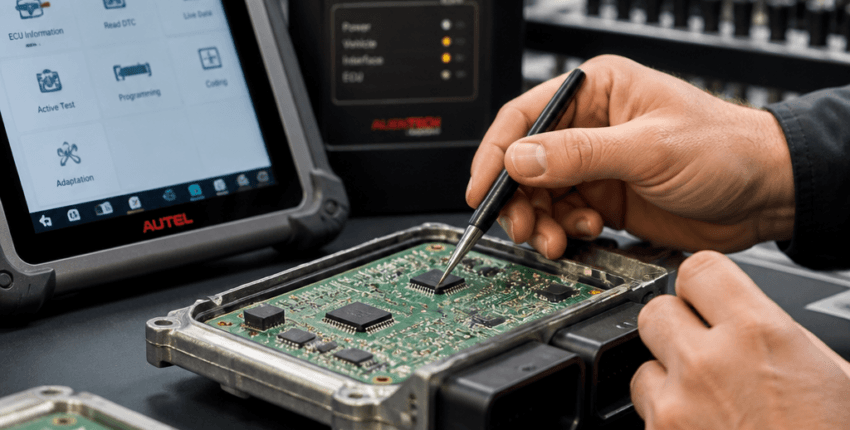
Swap a module on a modern vehicle without programming it correctly and the car will not start, shift gears, brake predictably, or talk to any of the other computers on the network. That is not an exaggeration. Module programming is the step that turns a blank or replacement electronic control unit into a functioning brain for your specific vehicle, and it requires OEM-level tools, manufacturer credentials, and hands-on diagnostic experience. If you are searching for module programming Townsville, you need to understand exactly what this work involves before handing your keys to anyone who claims they can do it. The difference between a specialist and a generalist in this space can mean the difference between a fixed car and an expensive brick.
Table of Contents
- Quick Takeaways
- What Is Module Programming and Why Does It Matter?
- Which Modules Need Programming in Your Vehicle?
- ECU Cloning vs. Module Programming: When Each Applies
- The Real Risks of Getting This Wrong
- What a True Automotive Electronics Specialist Brings to Townsville
- Comparing Your Options in Townsville
- Frequently Asked Questions
- References
Quick Takeaways
| Key Insight | Explanation |
|---|---|
| Modules do not work out of the box | Any replacement ECU, TCM, BCM, or ABS module arrives blank or with generic calibration. It must be programmed to your vehicle’s VIN and configuration before the car will function correctly. |
| OEM tools are non-negotiable | Generic OBD-II scanners cannot write software to a module. Programming requires manufacturer-specific platforms such as Ford IDS/FDRS, Toyota TIS, or GM GDS2, plus valid access credentials. |
| ECU cloning saves money when the original is damaged | If your original module is physically intact but has a failed processor, cloning copies the exact calibration data to a replacement unit, avoiding costly dealer re-commissioning fees. |
| Electronic transmission repairs are a separate discipline | Transmission control modules require adaptive learning resets and specific calibration sequences after replacement. A general mechanic will not have the tooling to complete this correctly. |
| Misprogrammed modules can trigger cascading faults | One incorrectly programmed module can cause false fault codes across multiple other systems, making diagnosis exponentially harder and more expensive. |
| All brands require different approaches | A Mazda CX-5, a Mercedes-Benz Sprinter, and a Holden Colorado each use a different programming protocol, security gateway, and calibration file. A specialist works across all of them. |
| Advanced diagnostics must come before programming | Programming a replacement module before completing a root-cause diagnosis is a common and costly mistake. The new module will fail for the same reason as the old one if the underlying fault is not resolved first. |
What Is Module Programming and Why Does It Matter?
Inside every vehicle built in the last two decades, there is not one computer but dozens. Each of those computers is called an electronic control unit, or ECU, and together they form a networked system that governs everything from fuel injection and gear changes to airbag deployment and adaptive cruise control. Module programming is the process of writing the correct software, calibration data, and vehicle-specific parameters onto one or more of those control units so they can communicate and operate as intended.
When a module is replaced, whether because of failure, water damage, heat damage, or a collision, the replacement unit does not automatically know what vehicle it belongs to. It arrives with either blank memory or a generic factory base calibration that has never been matched to your specific VIN, options, and regional settings. Programming is what bridges that gap. Without it, the vehicle may crank but not start, display persistent warning lights, refuse to engage certain safety systems, or behave erratically in ways that a standard scan tool cannot diagnose.
Module programming is also required outside of replacement scenarios. Software updates issued by manufacturers to correct drivability problems, update emission calibrations, or patch security vulnerabilities must be written to the relevant module using the correct OEM tool. Performance modifications that change fuelling, boost pressure, or gear shift points also require module-level changes, not just parameter adjustments through an aftermarket tuning device.
Programming a replacement module before completing a root-cause diagnosis is one of the most common and costly mistakes in automotive electronics repair. The new unit will develop the same fault if the underlying electrical problem has not been resolved first.
Pro tip: Always insist on a full advanced diagnostic scan before any module is replaced or programmed. Any reputable specialist will perform this step as standard, not as an optional add-on.
Which Modules Need Programming in Your Vehicle?
The list of programmable modules in a modern vehicle is longer than most drivers realise. Understanding which systems are involved helps you ask better questions of any workshop, and it helps you spot a shop that is out of its depth.
Engine and Powertrain Control
The Engine Control Module (ECM, also called ECU, PCM, or DME depending on the manufacturer) manages fuel injection, ignition timing, turbo boost pressure, emissions controls, and idle speed. Any replacement requires programming with the correct calibration files and VIN data. In many modern vehicles, the ECM must also be paired to the immobiliser system, which adds another layer of complexity that a generic workshop cannot handle.
Transmission Control
The Transmission Control Module (TCM) governs shift points, torque converter lockup, and adaptive learning in automatic and dual-clutch transmissions. After replacement, the TCM must be programmed and the adaptive shift data must be reset and relearned. Skipping this step produces harsh shifts, early or late gear changes, and in some cases converter slippage. Electronic transmission repairs are a dedicated discipline, not a subset of general auto electrical work.
Body and Safety Systems
The Body Control Module (BCM) handles lighting, power windows, central locking, and accessories. The ABS and stability control module governs braking intervention. The Supplemental Restraint System (SRS) module controls airbag deployment. The instrument cluster, HVAC control head, power steering module, and parking assist cameras all fall into this category as well. Each of these modules requires programming after replacement, and some require coding to match the options fitted to your specific vehicle.
Advanced Driver Assistance Systems
ADAS components including forward collision warning, lane-keep assist, adaptive cruise radar, and blind-spot monitoring systems require both module programming and physical calibration of the sensors after replacement or even after certain types of collision repair. This is a growing area of complexity that most general mechanics in Townsville are not equipped to handle.
ECU Cloning vs. Module Programming: When Each Applies
These two terms are sometimes used interchangeably, but they describe different processes and apply to different situations. Knowing the distinction saves you money and helps you identify the right solution for your vehicle.
Module programming involves writing fresh software and calibration data to a new or replacement module. The programming data comes from the manufacturer’s server or a locally held calibration file, matched to your vehicle’s VIN and specifications. This is the appropriate approach when fitting a brand-new module, performing a software update, or correcting a calibration error.
ECU cloning is a different process. It involves reading the complete data from a damaged or failing original module, including the learned adaptations, security pairing, and calibration data specific to that vehicle, and then writing an exact copy of that data onto a replacement unit. Cloning is the correct solution when the original module contains unique data that cannot be retrieved from a manufacturer server, when the vehicle’s history of learned adaptations needs to be preserved, or when the manufacturer does not permit reuse of second-hand programmed units through standard OTA channels.
In practice, some vehicle makes and models genuinely require cloning rather than standard programming because their security architecture does not allow a new module to be paired through the dealer network without specialist bypass tools. A shop that only offers one of these two services is not equipped to handle the full range of scenarios your vehicle might present.
Pro tip: If a workshop cannot clearly explain whether your situation calls for cloning or fresh programming, and why, that is a reliable indicator they do not have the experience or tooling to do the job correctly.
The Real Risks of Getting This Wrong
The consequences of incorrect module programming are not theoretical. They are the kinds of outcomes that drive workshop calls asking us to fix someone else’s mistakes, and they are consistently more expensive to resolve than getting the job done correctly the first time.
Failed Programming Leaves You Stranded
If the programming process is interrupted, whether by an unstable power supply, a software timeout, or an incompatible calibration file, the module can be left in a partial or corrupt state. A module in this condition will not function at all. Recovery requires specialist intervention with the correct tools, and in some cases the module must be replaced entirely. This is why battery support units and controlled voltage environments are non-negotiable during any programming session.
Cascading Fault Codes Across Multiple Systems
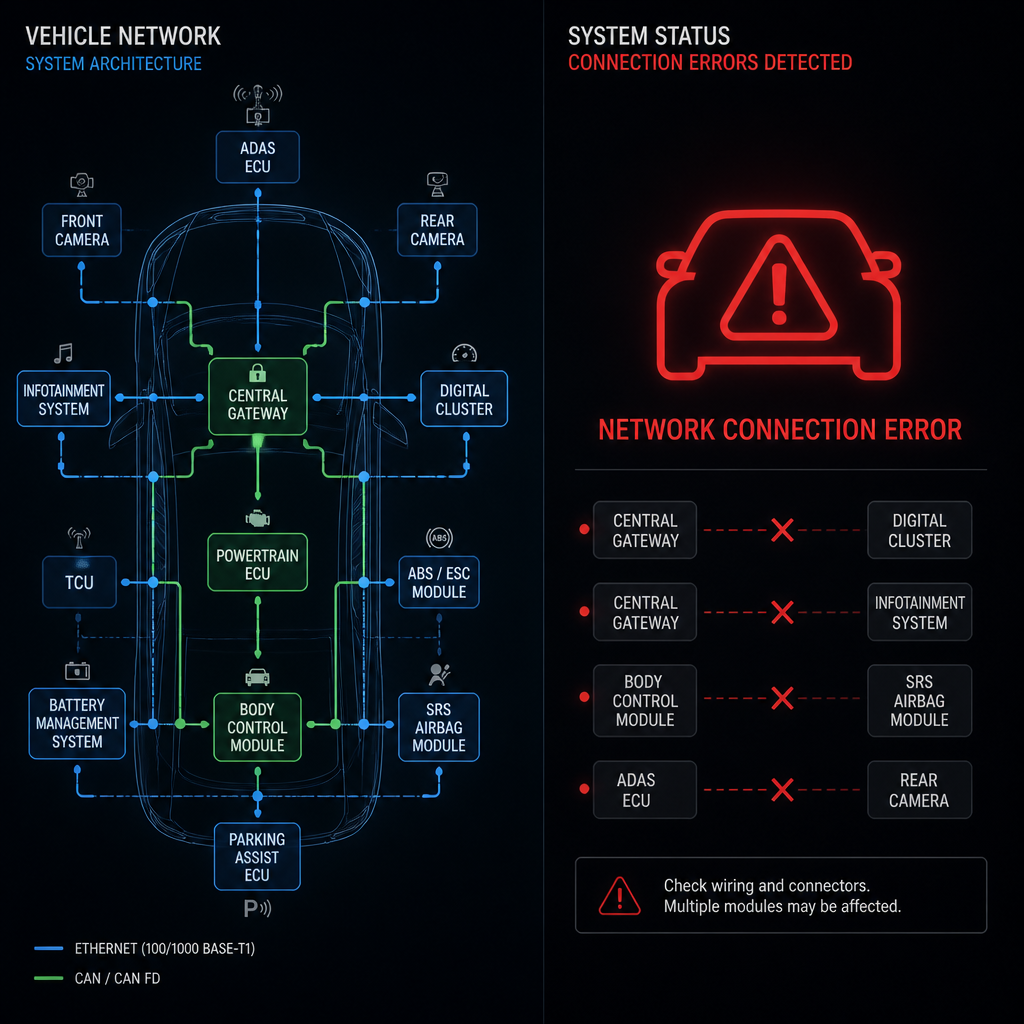
A module that has been programmed with the wrong calibration file for its network configuration will generate fault codes not only in its own system but in every other module on the vehicle network that it communicates with. Diagnosing these cascading faults without understanding their root cause wastes significant time and money. A scan tool that shows twelve different fault codes across eight systems is often the result of a single misprogrammed module, not twelve independent failures.
Security and Immobiliser Lockouts
Modern vehicles use cryptographic pairing between the ECM, the immobiliser, and the key. A programming attempt that fails to complete the security sequence correctly can lock the vehicle in a state where it will not start at all, and where standard diagnostic tools cannot access the ECM to attempt a repair. Resolving an immobiliser lockout caused by an incorrect programming attempt is one of the more time-consuming and expensive recovery jobs in automotive electronics.
What a True Automotive Electronics Specialist Brings to Townsville
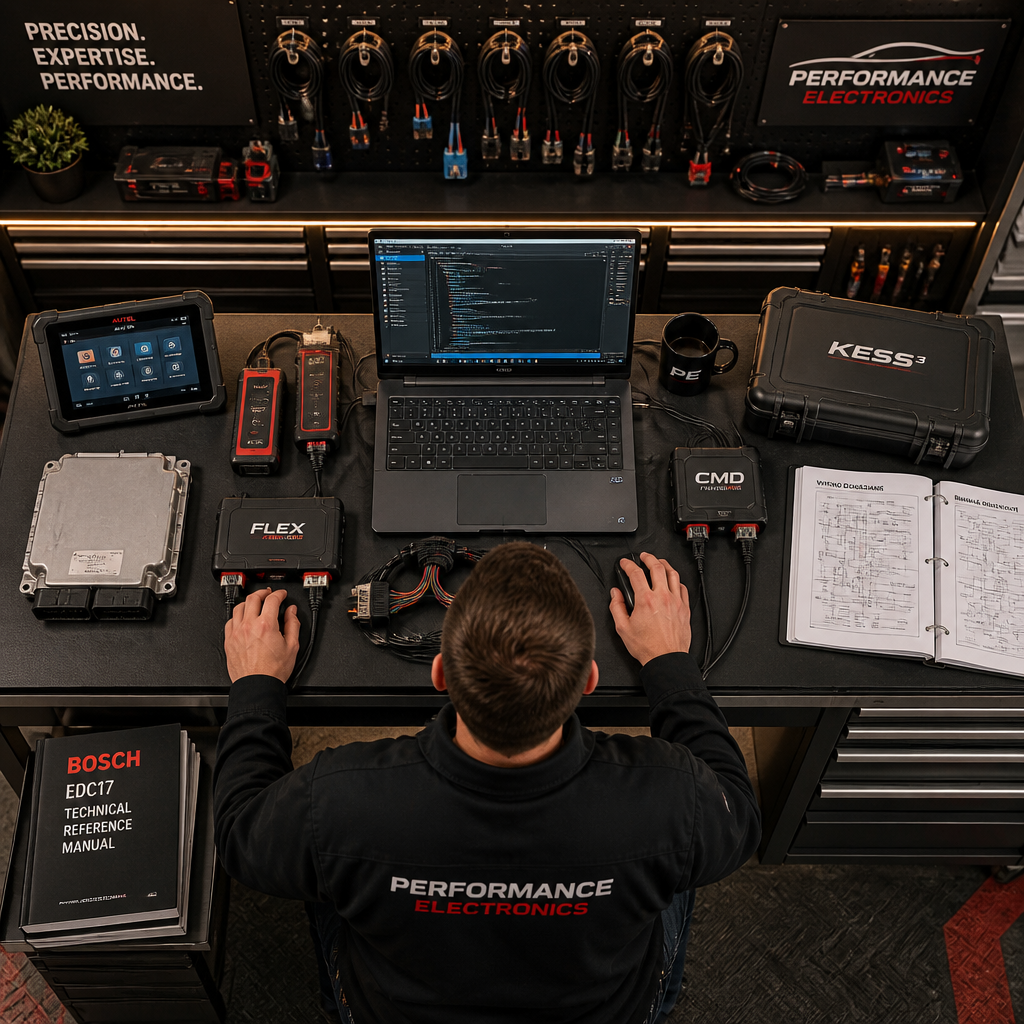
The gap between a general auto electrician and a genuine automotive module programming specialist is wider than most vehicle owners realise. The tooling alone represents a significant investment, and the tooling is only useful if the technician understands the system architecture behind it.
OEM-Level Diagnostic and Programming Tools
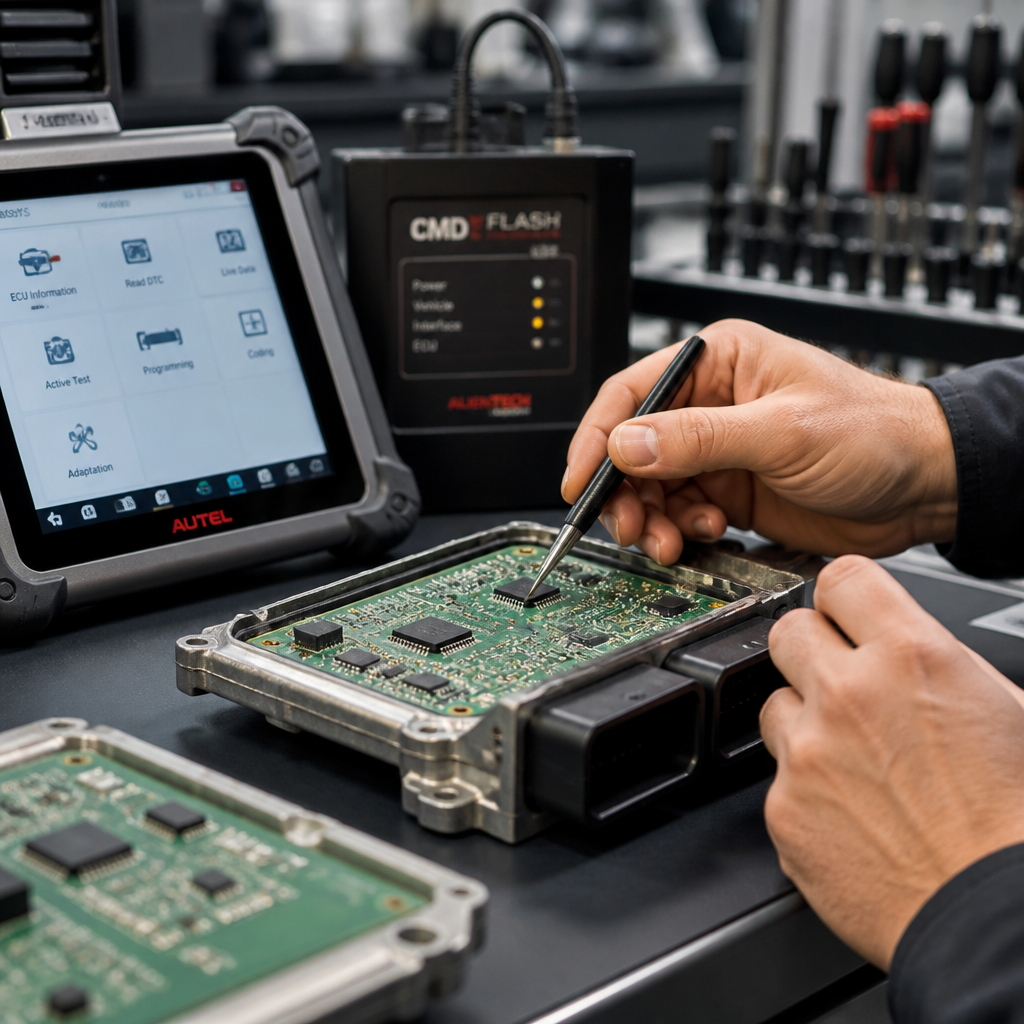
Genuine module programming requires access to manufacturer-specific platforms. These include Ford IDS and FDRS, Toyota TIS Techstream, GM GDS2, Chrysler wiTECH, BMW ISTA, and equivalent platforms for every other brand sold in Australia. Each platform requires a valid subscription and, in some cases, direct server access during the programming event. A specialist workshop covering all vehicle brands maintains active access to all of these systems, not just one or two.
Dedicated ECU Repair and Cloning Hardware
Beyond OEM programming tools, proper ECU cloning and repair requires dedicated hardware that can read and write directly to the module’s memory chips, including EEPROM and flash memory, bypassing the vehicle network when necessary. This is the equipment that allows a damaged module to be recovered, cloned, or repaired at the component level rather than simply replaced at the vehicle owner’s expense.
Multi-Brand Experience Across All Vehicle Types
Townsville’s vehicle population is diverse. The region runs everything from Japanese and Korean passenger vehicles to European prestige cars, American pickup trucks, and a significant population of commercial and agricultural vehicles. A specialist who has only ever worked on Toyota and Holden does not have the diagnostic depth to correctly handle a late-model Ford Ranger PATS immobiliser programming event or a Mercedes-Benz Sprinter SCN coding requirement. Multi-brand experience is not a marketing claim. It is a technical reality with measurable consequences.
Twin Cities Auto operates as Townsville’s most advanced automotive workshop precisely because the team covers this full spectrum. Module programming, ECU repairs and cloning, electronic transmission repairs, auto electrical work, and advanced diagnostics are delivered under one roof, with the tools and credentials to handle every brand sold in Australia. That is a fundamentally different offer from a general mechanic who has purchased a mid-range aftermarket scan tool.
Comparing Your Options in Townsville
| Service Type | What They Can Actually Do | Limitations to Know |
|---|---|---|
| General Mechanic or Auto Electrician | Basic fault code reading with aftermarket scan tools, standard wiring repairs, sensor replacements | Cannot write software to modules. Cannot perform OEM programming, cloning, or immobiliser key coding. Often refers complex electronic jobs elsewhere. |
| Dealership Service Department | OEM programming for their specific brand using factory tools, software updates, recall work | Single-brand scope. Cannot work on other manufacturers. Programming fees can be significantly higher. Cloning services are rarely offered. Lead times for parts and technician availability vary. |
| Twin Cities Auto (Specialist Workshop) | Module programming, ECU repair and cloning, electronic transmission repairs, advanced diagnostics, auto electrical repairs across all vehicle brands in Australia | Not a tyre or panel shop. Focused on electronics and programming work, which is exactly the specialisation this type of repair demands. |
Frequently Asked Questions
What vehicles does module programming apply to?
Any vehicle manufactured in approximately the last 20 years will have one or more modules that require programming when replaced. This includes passenger cars, SUVs, utes, commercial vans, trucks, and agricultural machinery. The complexity varies by make and model, but no modern vehicle brand is exempt. Japanese, Korean, European, American, and Australian-market vehicles all require brand-specific programming tools and procedures.
How do I know if my vehicle needs module programming rather than a simple part replacement?
The clearest indicator is a vehicle that does not behave correctly after a part has been replaced, or one that presents multiple warning lights that a basic scan tool cannot trace to a clear cause. Any replacement of an ECU, TCM, BCM, ABS module, airbag module, instrument cluster, or immobiliser component will require programming. If a workshop tells you a module is “plug and play” without qualification, ask them specifically how they will handle VIN matching and immobiliser pairing. If they cannot answer, take the vehicle elsewhere.
Is ECU cloning legal in Australia?
ECU cloning for repair purposes, meaning restoring a vehicle to its original operating specification using data from its own original module, is a legitimate repair technique used by specialist workshops across Australia. It is a different activity from tune cloning or copying another vehicle’s calibration for the purposes of circumventing emissions or performance regulations. A reputable specialist will make this distinction clear and will only perform cloning for genuine repair scenarios.
Can a regular auto electrician in Townsville program modules?
A standard auto electrician can diagnose and repair wiring faults, replace sensors, and use aftermarket scan tools to read and clear fault codes. However, writing firmware or calibration data to a vehicle module requires OEM-level software, active manufacturer server access, and dedicated programming hardware. This equipment is a significant investment and is not typically found in a general auto electrical workshop. The difference matters practically, not just theoretically, because an incorrect programming attempt can leave a module in an unrecoverable state.
How long does module programming typically take?
The duration depends on the module type, the vehicle brand, and whether the job also involves advanced diagnostics to identify the root cause of the failure. A straightforward programming event for a single module can take anywhere from 30 minutes to a few hours, including the pre-programming diagnostic work. Jobs involving ECU cloning, immobiliser pairing, or ADAS sensor calibration take longer. Any workshop that quotes a precise time without first completing a diagnostic assessment is guessing.
What is the risk of using an overseas or mail-in ECU programming service?
Mail-in ECU services remove the module from the vehicle, send it to a third party, and return it programmed or cloned. The significant problem with this approach is that a thorough root-cause diagnosis cannot be completed while the module is absent from the vehicle. If the underlying electrical fault that caused the original module failure, such as a wiring short, a failing power supply, or a sensor providing incorrect data, has not been identified and corrected before the reprogrammed unit is installed, the replacement module will develop the same fault. Local specialist workshops eliminate this risk by diagnosing and repairing the vehicle as a complete system.
Have you experienced module programming issues with your vehicle, or dealt with a workshop that was out of its depth with automotive electronics? Share your experience in the comments or contact the team at Twin Cities Auto directly to discuss your vehicle’s situation.
References
- Guide to which vehicle modules require programming when replaced, covering ECU, TCM, BCM, ABS, and ADAS systems
- Explainer on what module programming is in modern cars and the scenarios that require it
- Overview of OEM software requirements and what to look for in a qualified module programming service provider
- Technical overview of ECU programming, when it is needed, and the risks of improper execution
- Car owner’s guide to ECU programming covering risks, controlled environments, and professional execution requirements