
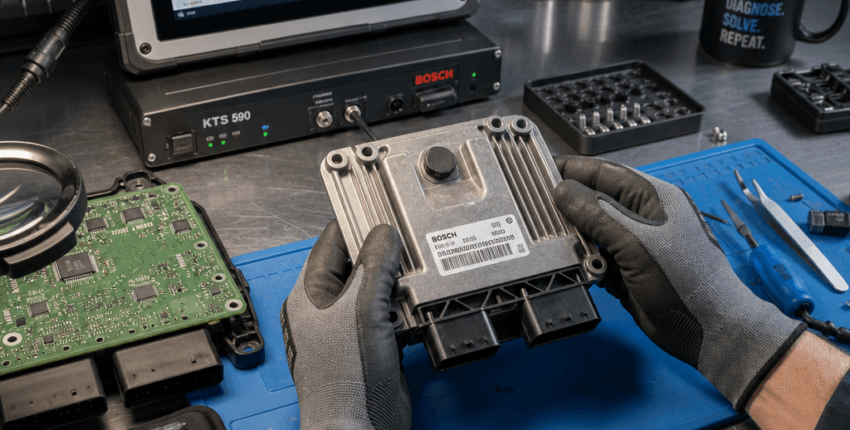
Most Townsville motorists get quoted $800 to $2,500 for a brand-new ECU replacement when their car throws a fault code. What those motorists rarely hear is that the same problem can often be fixed for $150 to $400 through proper ECU repair in Townsville. The difference is not luck. It comes down to whether your workshop has the diagnostics depth and electronic repair capability to tell you the truth about what is actually wrong. This guide breaks down the real cost comparison, explains when each option makes sense, and shows you exactly what to ask before spending a dollar.
Table of Contents
- What Does an ECU Actually Do
- Quick Takeaways
- The Real Cost Breakdown: Repair vs Replacement
- When ECU Repair Is the Right Answer
- When Replacement or Cloning Is Necessary
- ECU Cloning Townsville: The Option Most Workshops Cannot Offer
- Module Programming Townsville: Why It Matters After Any ECU Work
- Comparison: Repair vs Replacement vs Cloning
- What Advanced Diagnostics Reveals Before You Spend Anything
- Frequently Asked Questions
- References
What Does an ECU Actually Do
An Engine Control Unit is the brain that manages fuel injection timing, ignition control, emissions systems, and communication between every electronic module in your vehicle. Modern vehicles carry between 50 and 150 electronic control modules depending on the make and model. The ECU is the primary unit that all other modules report to.
When an ECU fails, the symptoms can look like almost anything. Misfires, stalling, transmission shift issues, immobiliser lockouts, and even power steering faults can all trace back to a single ECU fault. A common mistake is assuming the symptom points directly to the failed component. In practice, without live data diagnostics, workshops guess and parts-swap, which costs you money every time they are wrong.
Quick Takeaways
| Key Insight | Explanation |
|---|---|
| Repair is almost always cheaper than replacement | ECU component-level repairs typically cost $150 to $400 versus $800 to $2,500 for OEM replacement units sourced in Australia. |
| A replacement ECU still needs programming | A new or secondhand ECU will not work until it is programmed to match your specific vehicle VIN, immobiliser, and transmission settings. |
| ECU cloning preserves all your vehicle-specific data | Cloning transfers the exact memory content from your faulty ECU to a new unit, eliminating the need for dealer-level key and immobiliser relearns. |
| Advanced diagnostics prevents unnecessary ECU replacement | Many ECU fault codes are caused by sensor failures or wiring faults, not ECU damage. Proper diagnostics identifies the real root cause first. |
| Not every workshop in Townsville can do this work | ECU repair, cloning, and module programming require specialist hardware and software that general mechanics and most auto electricians do not carry. |
| Secondhand ECUs from wreckers carry serious risk | A used ECU from a wrecker requires full reprogramming and may have hidden faults. It is rarely cheaper than a proper repair once all costs are counted. |
| Townsville heat accelerates ECU component failure | The North Queensland climate stresses solder joints and capacitors inside ECUs faster than in southern states, making repair a more frequent need locally. |
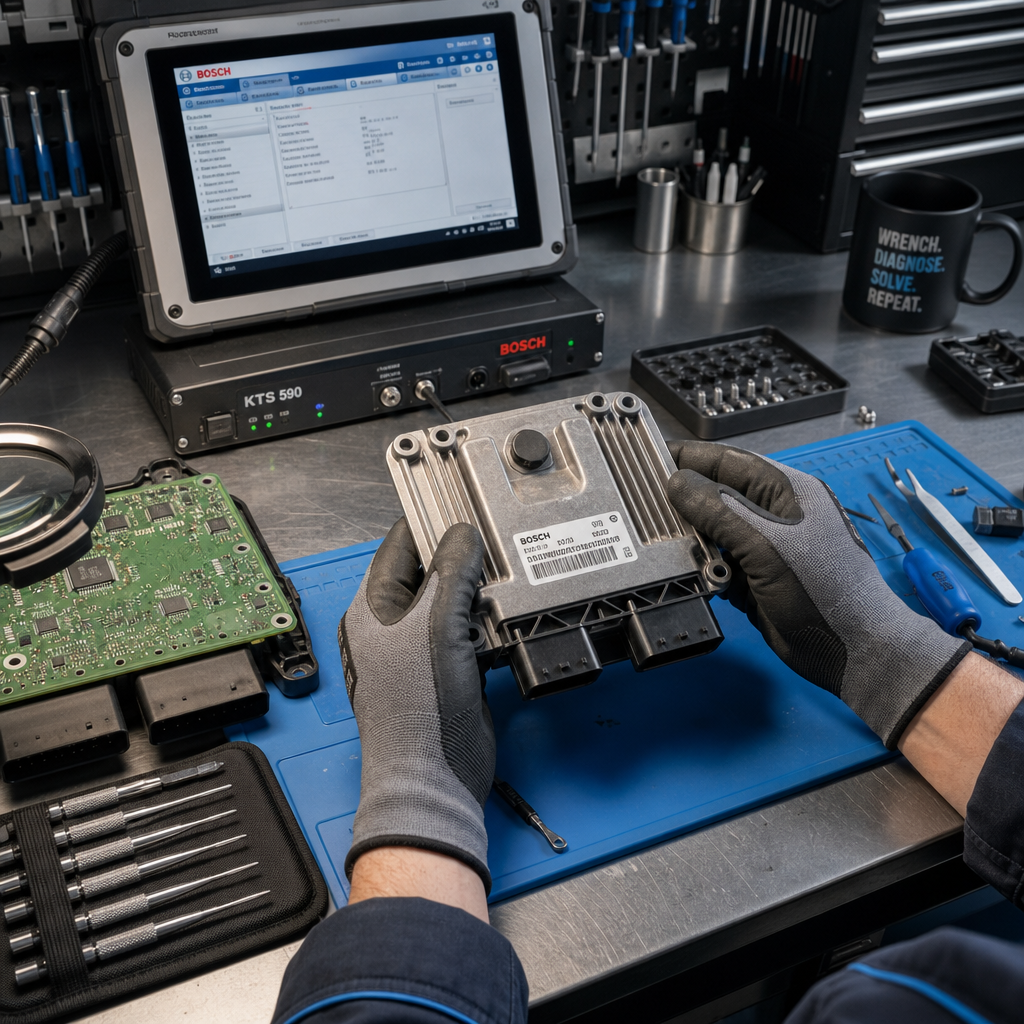
Understanding why ECU faults happen at a component level is what separates a workshop that repairs from one that simply replaces. The circuit boards inside most ECUs contain capacitors, voltage regulators, and processor chips that degrade over time. In Townsville specifically, the combination of heat, humidity, and coastal salt air accelerates that degradation faster than the national average.
The Real Cost Breakdown: Repair vs Replacement
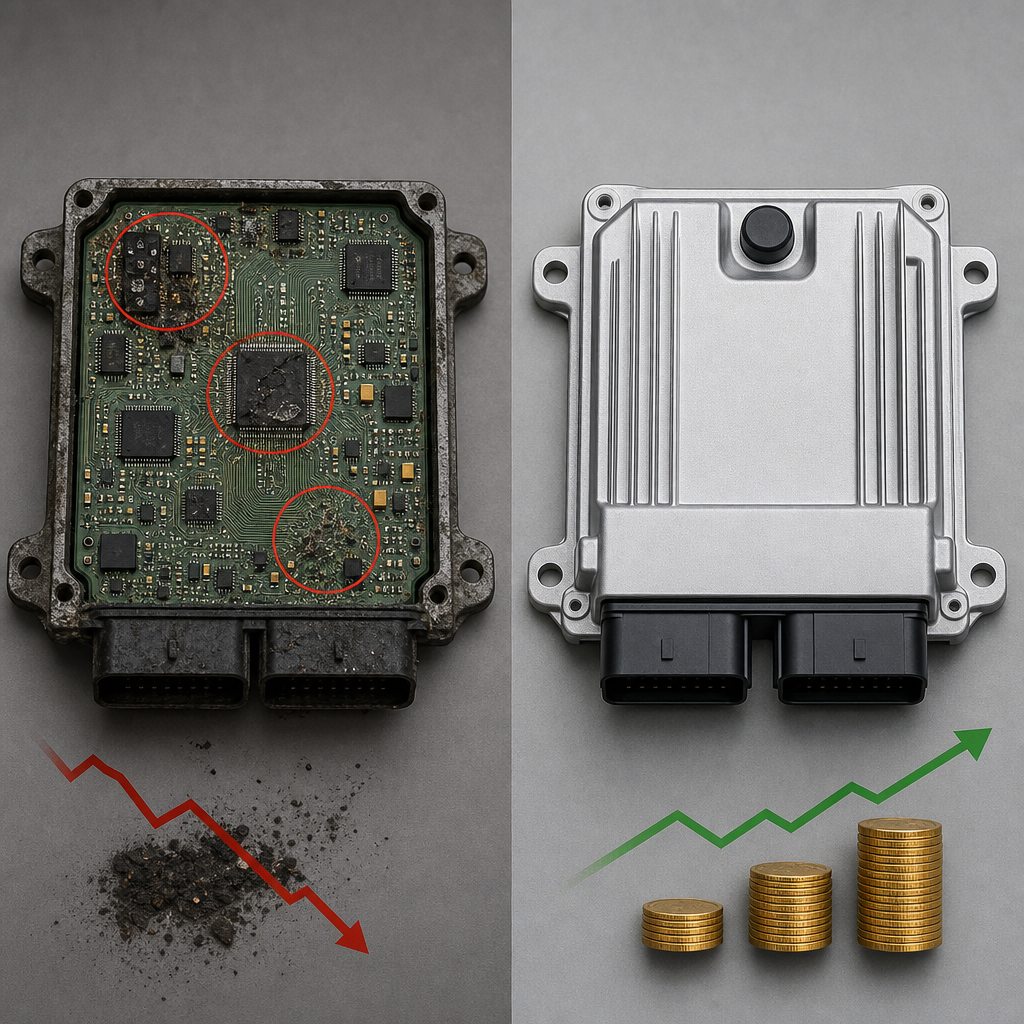
Here are the numbers based on what Townsville motorists actually face. A genuine OEM ECU for a common vehicle such as a Toyota HiLux, Ford Ranger, or Holden Colorado ranges from $900 to $2,500 depending on the model year and the level of technology involved. That price does not include programming, which adds another $150 to $400 in labour at a specialist workshop.
An aftermarket or remanufactured ECU from an overseas supplier brings that hardware cost down to roughly $350 to $700, but the programming cost remains the same, and quality control on offshore remanufactured units varies significantly.
A component-level ECU repair on the same vehicle, where the actual fault is identified and corrected at the board level, typically costs $150 to $400 total. That includes diagnostics, the repair, and bench testing before the unit goes back in the vehicle. The data consistently shows that repair is the lower-cost path in the majority of cases where the ECU is not physically destroyed by water ingress or a severe electrical event.
Pro tip: Always ask for a written diagnostics report before authorising any ECU work. If a workshop cannot tell you exactly which component or circuit failed and why, you are paying for a guess, not a repair.
When ECU Repair Is the Right Answer
ECU repair is the correct path when the fault is internal to the unit, the housing is physically intact, and the memory data is still recoverable. The most common repairable ECU faults involve failed voltage regulators, blown output drivers, degraded capacitors, and corrupted flash memory that can be reflashed.
Voltage Regulator Failure
This is one of the most common ECU faults across Toyota, Mitsubishi, and Ford platforms in Australia. The internal voltage regulator feeds the processor a clean 5-volt supply. When it fails, the processor behaves erratically, throwing random fault codes across multiple systems. Replacing the regulator at the component level resolves the fault completely.
Output Driver Failure
Injector drivers, solenoid drivers, and relay control outputs are the most stress-tested circuits in any ECU. They carry current directly and fail due to short circuits elsewhere in the vehicle. A short on an injector harness can kill an output driver in seconds. Repairing the driver circuit and fixing the root-cause wiring fault is far cheaper than replacing the entire ECU.
Corrupted Flash Memory
Software corruption happens due to failed updates, power interruptions during programming, or battery faults. In practice, a corrupted ECU that has physically intact hardware can be recovered through a bench reflash in most cases, restoring full function without any hardware replacement at all.
When Replacement or Cloning Is Necessary
There are genuine scenarios where repair is not possible. Physical destruction from water immersion, fire, or a severe voltage spike that burns multiple layers of the circuit board simultaneously falls into this category. When the processor itself is destroyed or the board is physically damaged beyond repair, replacement is the only path.
Theft damage is another scenario. Vehicles that have had their ECU removed or damaged by thieves attempting to bypass the immobiliser system often arrive with units that are too damaged for board-level repair. In these cases, ECU cloning in Townsville becomes the most practical solution because it allows a new unit to be programmed with the exact configuration of the original without requiring dealer relearns.
ECU Cloning Townsville: The Option Most Workshops Cannot Offer
ECU cloning is the process of reading the complete memory content from an existing ECU, including the VIN coding, immobiliser data, calibration tables, and adaptive learning values, and writing that exact data image to a replacement unit. The result is a replacement ECU that the vehicle recognises as its own from the moment the ignition is turned on.
This matters because a standard ECU replacement from a dealer requires the vehicle to go through a key relearn, immobiliser coding, and often a transmission adaptation reset. That process can take additional hours of labour and, on some platforms, requires the vehicle to be connected to a dealer-level diagnostic system. Cloning bypasses all of that.
“ECU cloning done correctly is indistinguishable from having the original unit in the vehicle. The adaptive values, learned fuel trims, and transmission shift points are all preserved. The vehicle does not know anything changed.” – Twin Cities Auto, Townsville specialist workshop
The critical requirement for cloning to work is that the source ECU must still have readable memory. If the processor has failed in a way that prevents a clean read, the data cannot be transferred. This is why advanced diagnostics before any ECU decision is not optional, it is the starting point for every job done correctly.
Pro tip: When comparing quotes for ECU work in Townsville, ask specifically whether the workshop can perform ECU cloning and whether they carry the programming hardware to code a new unit to your vehicle in-house. If the answer to either question is no, you are likely looking at a longer turnaround and higher cost.
Module Programming Townsville: Why It Matters After Any ECU Work
Any time an ECU is repaired, replaced, or cloned, the surrounding modules in the vehicle need to be verified and in some cases reprogrammed. Modern vehicles use a Controller Area Network where the ECU communicates constantly with the transmission control module, the ABS module, the body control module, and the instrument cluster.
Module programming in Townsville is the process of writing correct calibration and configuration data to each module to ensure the network functions as a system. If one module holds a software version that conflicts with the newly installed or repaired ECU, the result is fault codes, limp mode, or warning lights that have nothing to do with the original fault.
Transmission Module Programming
Electronic transmission repairs and programming are a specific area where getting the post-ECU work right is critical. Automatic transmissions on Ford, GM, and Toyota platforms store adaptive shift data in both the ECU and the TCM. After any ECU work, verifying the transmission module calibration prevents premature shift complaints and protects the gearbox from damage caused by incorrect solenoid timing.
Immobiliser and Key Coding
Immobiliser systems on European vehicles in particular, BMW, Mercedes, Volkswagen Group, and Peugeot-Citroen platforms, require careful key coding after any ECU change. A replacement ECU that has not been correctly coded to the immobiliser ring will leave the vehicle unable to start. Cloning handles this automatically, but replacement units require this step to be completed with professional-grade equipment.
Comparison: Repair vs Replacement vs Cloning
| Option | Typical Cost Range (AUD) | Best Suited For |
|---|---|---|
| ECU Component-Level Repair | $150 to $400 | Repairable internal faults with intact housing and recoverable memory. Most common scenario for Townsville vehicles with heat-related component failure. |
| ECU Replacement with Module Programming | $900 to $2,900 | Physically destroyed ECU, unrecoverable memory corruption, or vehicles where dealer new-unit supply is the only option. Highest cost but covers total board destruction scenarios. |
| ECU Cloning | $300 to $700 | Replacement needed but original data must be preserved. Theft damage, physical destruction with readable memory, or vehicles where immobiliser relearn is impractical. Preserves adaptive values and eliminates relearn procedures. |
What Advanced Diagnostics Reveals Before You Spend Anything
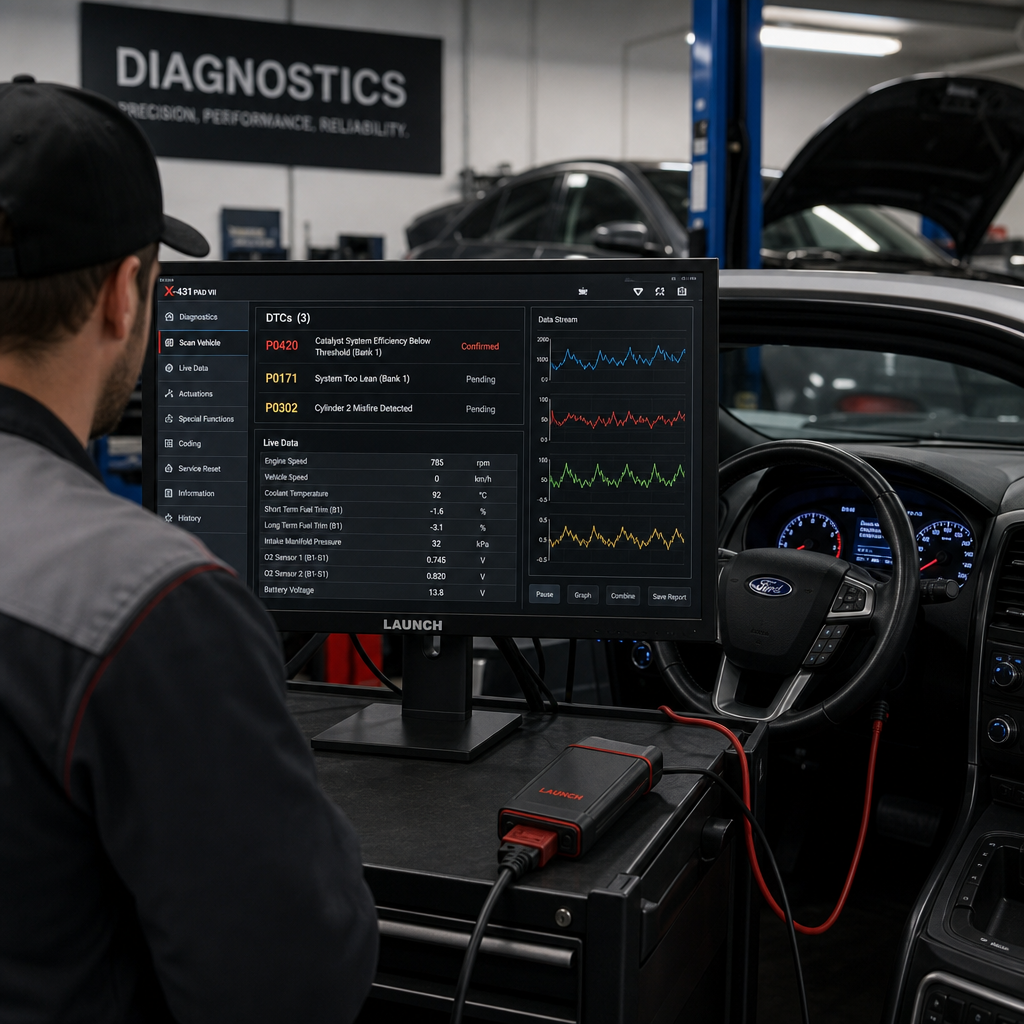
The single most expensive mistake Townsville motorists make is authorising ECU replacement based on a fault code alone. Fault codes indicate a system fault. They do not confirm which component caused it. A code pointing to the ECU could originate from a $15 sensor, a corroded connector, or a damaged earth strap as easily as from the ECU itself.
Advanced diagnostics using professional scan tools that read live data, perform actuator tests, and compare actual versus expected values is what separates a correct diagnosis from a parts-replacement gamble. According to the Australian Automotive Aftermarket Association, misdiagnosis is one of the top three causes of repeat workshop visits for the same fault.
At a workshop with genuine advanced diagnostics capability, the process before any ECU decision looks like this: live data logging under the fault condition, oscilloscope testing of sensor signals and power supplies to the ECU, bi-directional control testing of ECU outputs, and a bench test of the ECU unit itself if the in-vehicle tests are inconclusive. That process takes time but it costs far less than an unnecessary ECU replacement.
Frequently Asked Questions
How do I know if my ECU actually needs replacing or just repairing?
The only reliable way to know is through advanced diagnostics, not a fault code reading alone. A workshop with live data capability and ECU bench testing equipment can tell you within a short inspection whether the fault is internal to the ECU or caused by something in the wiring or sensor network feeding it. If a workshop quotes you for ECU replacement without performing that level of diagnostics first, get a second opinion.
Can a repaired ECU fail again sooner than a new one?
A properly executed component-level repair replaces the failed part with a correct specification replacement component and verifies the repair on a bench before reinstallation. In practice, a correctly repaired ECU performs reliably for the remaining life of the vehicle. The failure rate of a competent repair is not meaningfully higher than that of a new unit. Poorly executed repairs using incorrect-grade components are the real risk, which is why choosing a specialist matters.
Is ECU cloning legal in Australia?
ECU cloning for the purpose of vehicle repair and restoration is legal in Australia. You are transferring your own vehicle data from one unit to another. Cloning to defeat emissions controls or to facilitate vehicle theft is not legal, but those scenarios are unrelated to legitimate repair work. A reputable workshop will only perform cloning in the context of documented repair work on a vehicle the customer owns or is authorised to have repaired.
Why do Townsville vehicles seem to have more ECU problems than in southern states?
North Queensland’s heat and humidity create accelerated stress on electronic components. Solder joints expand and contract with daily temperature cycles far more dramatically in Townsville than in Melbourne or Sydney. Capacitors inside ECUs degrade faster in sustained high temperatures. Coastal proximity adds salt humidity to the mix, which accelerates corrosion on circuit board traces and connector pins. These are real, measurable factors that make ECU repair a more frequently needed service in this region.
What is the difference between ECU cloning and ECU tuning?
ECU cloning copies existing data from one unit to another without changing calibration values. The vehicle runs exactly as it did before. ECU tuning modifies the calibration data to alter performance characteristics such as fuel maps, boost pressure, or ignition timing. They use some of the same programming hardware but serve completely different purposes. Cloning is a repair process. Tuning is a performance modification. Both require specialist equipment that most general workshops in Townsville do not carry.
How long does ECU repair or cloning take at a specialist workshop?
Component-level ECU repair typically takes one to three business days depending on whether parts need to be ordered. ECU cloning can often be completed same day if the replacement unit is in stock and the source ECU has readable memory. Module programming after either process adds one to two hours of labour in most cases. A workshop that quotes weeks for this work is either outsourcing it or lacks the in-house capability to do it directly.
Have you had an ECU issue on your vehicle in Townsville? Share what your experience was with diagnosis and repair below, your account might help another local motorist make a better decision.
References
- Global automotive electronics market data and repair industry statistics on Statista
- Forbes coverage of automotive technology costs and consumer repair trends
- Australian Government Department of Infrastructure transport and vehicle standards information
- Australian Competition and Consumer Commission guidance on consumer rights for vehicle repairs
- Ahrefs research blog covering data-driven insights into consumer search behaviour for automotive services